
Categories
When it comes to social customs and norms, few practices are as divisive as tipping expectations. How much to tip? Should you still tip if the service was poor? Which service industries are acceptable to leave a tip?
Societal expectations can vary significantly across different regions, so we decided to find out exactly how people feel about tipping.
Using CintSnap – a way to survey individuals and understand opinions quickly – we conducted a poll with approximately 300 respondents for each question in both the United States and the United Kingdom to shed light on consumer attitudes towards gratuity. We unravel preferences, inclinations, and how the introduction of digital payments impacts tipping behavior.
 Tipping practices across the US and the UK vary significantly in the survey findings. For starters, a large majority (90%) of respondents in the US expressed willingness to tip service staff at restaurants, compared to 71% in the UK.
However, when it comes to the amount tipped, disparities become more pronounced. In the US, over half of respondents favored tipping between 15-20% of the total bill, followed by a notable 21% who tip 20% or more. Conversely, in the UK, the prevailing trend leaned towards a more conservative approach, with around a third polled opting to tip between 10-15%, followed by 24% tipping less than 10%.
Tipping also often extends beyond just dining establishments. In the US, tipping customs extend to hairdressers (72%), bars (69%), and transportation services like Ubers or taxis (64%). There is a more restrained propensity in the UK for tipping outside of restaurants, with significantly lower percentages tipping in other sectors such as hairdressing (49%) and transportation (50%).
The advent of digital transactions has introduced a new dynamic to tipping. Has this left consumers with any apprehensions? A notable number of respondents in both countries voiced concerns about the efficacy of digital tips reaching the intended recipients – 32% in the US and 53% in the UK who were polled.
Despite this, preferences are split when it comes to digital versus cash tipping. While 41% of US respondents prefer digital tipping for its convenience, a high number of UK respondents (62%) still favor cash gratuities.
Tipping practices across the US and the UK vary significantly in the survey findings. For starters, a large majority (90%) of respondents in the US expressed willingness to tip service staff at restaurants, compared to 71% in the UK.
However, when it comes to the amount tipped, disparities become more pronounced. In the US, over half of respondents favored tipping between 15-20% of the total bill, followed by a notable 21% who tip 20% or more. Conversely, in the UK, the prevailing trend leaned towards a more conservative approach, with around a third polled opting to tip between 10-15%, followed by 24% tipping less than 10%.
Tipping also often extends beyond just dining establishments. In the US, tipping customs extend to hairdressers (72%), bars (69%), and transportation services like Ubers or taxis (64%). There is a more restrained propensity in the UK for tipping outside of restaurants, with significantly lower percentages tipping in other sectors such as hairdressing (49%) and transportation (50%).
The advent of digital transactions has introduced a new dynamic to tipping. Has this left consumers with any apprehensions? A notable number of respondents in both countries voiced concerns about the efficacy of digital tips reaching the intended recipients – 32% in the US and 53% in the UK who were polled.
Despite this, preferences are split when it comes to digital versus cash tipping. While 41% of US respondents prefer digital tipping for its convenience, a high number of UK respondents (62%) still favor cash gratuities.
General
 Tipping practices across the US and the UK vary significantly in the survey findings. For starters, a large majority (90%) of respondents in the US expressed willingness to tip service staff at restaurants, compared to 71% in the UK.
However, when it comes to the amount tipped, disparities become more pronounced. In the US, over half of respondents favored tipping between 15-20% of the total bill, followed by a notable 21% who tip 20% or more. Conversely, in the UK, the prevailing trend leaned towards a more conservative approach, with around a third polled opting to tip between 10-15%, followed by 24% tipping less than 10%.
Tipping practices across the US and the UK vary significantly in the survey findings. For starters, a large majority (90%) of respondents in the US expressed willingness to tip service staff at restaurants, compared to 71% in the UK.
However, when it comes to the amount tipped, disparities become more pronounced. In the US, over half of respondents favored tipping between 15-20% of the total bill, followed by a notable 21% who tip 20% or more. Conversely, in the UK, the prevailing trend leaned towards a more conservative approach, with around a third polled opting to tip between 10-15%, followed by 24% tipping less than 10%.
Experiences
When looking at the factors influencing tipping decisions, similarities are present across the borders. Friendliness, speed of service, and the quality of food stood out as important considerations for diners in both countries. However, some distinctions surfaced regarding tolerance for subpar service. While 68% of US respondents admitted to still tipping despite poor service, only 26% of UK respondents shared this sentiment.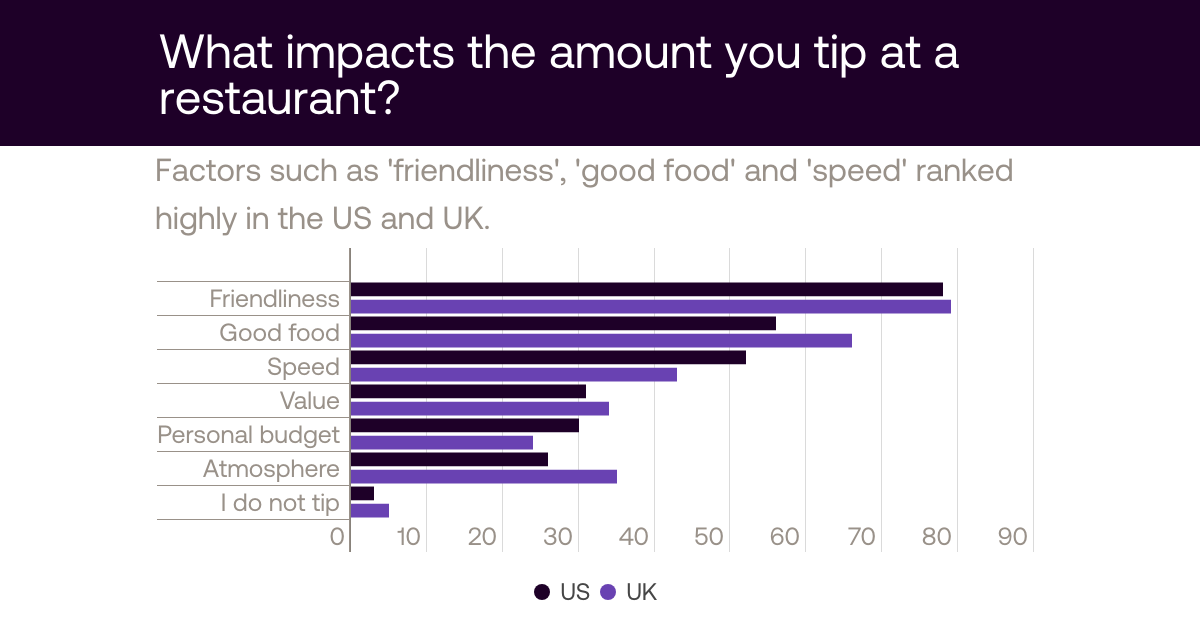 Tipping also often extends beyond just dining establishments. In the US, tipping customs extend to hairdressers (72%), bars (69%), and transportation services like Ubers or taxis (64%). There is a more restrained propensity in the UK for tipping outside of restaurants, with significantly lower percentages tipping in other sectors such as hairdressing (49%) and transportation (50%).
All about the $ & £..
The survey also unearthed shifting attitudes towards tipping in the face of economic realities. Approximately half of respondents in both countries expressed the possibility of tipping less due to rising inflationary pressures. In some countries, tipping can be the bread and butter of service industries. However, a resounding majority in both the US (85%) and the UK (90%) advocated for fair compensation to fall on employers, rather than relying on tips from patrons to boost staff wages.Going cashless
 The advent of digital transactions has introduced a new dynamic to tipping. Has this left consumers with any apprehensions? A notable number of respondents in both countries voiced concerns about the efficacy of digital tips reaching the intended recipients – 32% in the US and 53% in the UK who were polled.
Despite this, preferences are split when it comes to digital versus cash tipping. While 41% of US respondents prefer digital tipping for its convenience, a high number of UK respondents (62%) still favor cash gratuities.
The advent of digital transactions has introduced a new dynamic to tipping. Has this left consumers with any apprehensions? A notable number of respondents in both countries voiced concerns about the efficacy of digital tips reaching the intended recipients – 32% in the US and 53% in the UK who were polled.
Despite this, preferences are split when it comes to digital versus cash tipping. While 41% of US respondents prefer digital tipping for its convenience, a high number of UK respondents (62%) still favor cash gratuities.