
Contents
- Part 1 What’s and why’s of brand lift
- Introduction to cross-platform brand lift
- Meet the experts
- Why measure brand lift?
- How brand lift is calculated
- Why cross-platform lift matters
- About Lucid Measurement by Cint
- Part 2 Best practices for cross-platform measurement
- Be clear about your campaign goals
- Make sure your media placementsare trackable
- Understand what each platform in your mediamix adds to the campaign
- Ensure that you have enough impressions to draw meaningful insights
- Don’t be discouraged by negative lifts
- Act upon your insights
Summary
Measuring campaign success across fragmented digital channels is more challenging than ever. This comprehensive playbook serves as an expert-backed guide to understanding brand lift, setting accurate objectives, and tracking diverse media placements to maximize marketing impact.
Key Takeaways:
- The Core Metric: Demystifies brand lift and outlines precisely why it is crucial for proving and improving your marketing success.
- Actionable Optimization: Learn how to track and evaluate media placements in real-time, allowing you to fine-tune active campaigns on the fly.
- Expert Frameworks: Outlines three core strategies from industry leaders to streamline tracking and ensure your measurement setup captures true campaign value.
Part 1
What’s and why’s of brand lift
Understanding what drives brand lift helps brands optimize their marketing strategies for maximum effectiveness. Explore some of the key factors behind brand lift and how to leverage them for measurable success.
Introduction to cross-platform brand lift
Imagine you had a time machine but instead of taking you to walk among dinosaurs or to visit a utopian future where war, fossil fuels, and airport wait times have been rendered you obsolete, it takes you the start of a new year of advertising.
You see yourself preparing for an annual review of your media campaigns, poring over analyst reports from countless vendors, cross-referencing your media plans, and trying to make sense of measurement methodologies that include everything from viewable impressions to in-store coupon usage as part of a proprietary attribution model.
Each partner is giving you conflicting reasons as to why their methodology outperforms their competitors, leaving you with just two weeks to get your presentation signed off by the department VP.
In that time, you need to figure out not only how to make an apples-to-apples comparison between every channel on your media plan, but also where your vendors overlap with their reach, what optimizations were made to your media mix, and when and how those optimizations affected performance.
Has even imagining this hypothetical scenario engaged your fight or flight response? Take a deep breath, hold it in for a few seconds, and breathe out slowly. You’re in good company. There are a whole host of measurement companies dedicated to helping you solve the time-travel conundrum that’s landed in your lap.
You may even be one of the nonplussed readers working with one of those companies right now, here to get tips to pass off to your friendly neighborhood measurement partner, but before we get into all of that, let’s talk about your like-minded peers.
Various sources cite cross-platform measurement as a top priority for marketers. The good news, then, is that your particular problem is one that the measurement industry as a whole is trying to solve.
Even better, there are a handful of experts who have been working on solving the problem of cross-platform brand lift for a while now. In this playbook, we’re going to introduce you to a few of them, pick their brains, and hopefully give you some pointers that will save you weeks’ worth of work at some point in the next year.
Meet the experts
We asked a panel of experts here at Cint to share their combined 40+ years of measurement experience to help us find out what makes a cross-platform campaign successful, what makes cross-platform measurement challenging, and where the measurement industry is going.
We conducted hours of interviews, and while many of our experts’ answers were remarkably consistent, some were surprising, and some were downright controversial.

Laura Manning
SVP of Measurement, US, Cint
Laura Manning began her career at Cint 10 years ago as a project analyst. She is now SVP of Measurement at Cint where she leads the global media integrations and partnerships team. Her team focuses on expanding Cint relationships with DSPs, DMPs, SSPs, and ad platforms, as well as forging relationships with new data partners.

Julia Reuther
SVP of Measurement, US, Cint
Julia Reuther is an experienced professional in media measurement operations, currently serving as the Director of Project Success at Cint.

Stephanie Gall
Director, Measurement and Data Products, Cint
Stephanie Gall is an accomplished product management professional with extensive experience in leading strategic planning, feature development, and go-to-market initiatives across various companies. She currently serves as Director of Measurement and
Data Products at Cint.
Why measure brand lift?
“Half of the money I spend on advertising is wasted, and the trouble is I don’t know which half.”
David Ogilvy
Few marketers have been able to bring up the topic of measurement without referencing one of David Ogilvy’s most well-known quotes. Ad measurement has come a long way since those words were first put into publication in the 1960s, with the modern digital landscape offering a flurry of acronyms like CPA, ROAS, PPV, vCTR, and countless others as ways to measure whether an ad campaign is successful or not.
Brand lift falls into the category of metrics that we could almost call ‘older than the internet’ — the first banner display ad predates the first brand lift study by about one-and-one-half years, but, arguably, digital advertising was still seen as a novelty in 1996. However, the concept is simple enough.
If you can determine that someone has seen an ad, like by tracking their TV habits or surveying a relevant group from a subscriber list, you can then survey those individuals about how they perceive a brand. You can compare their responses to those of individuals who likely haven’t seen the ad.
Digital marketing has only made such surveys easier for measurement analysts, with tools like universal identity, S2S identity resolution, and the humble yet persistent cookie allowing more confident assessments of who has actually seen an ad and who has not. This allows brand lift to be something that can be measured in-flight, with the ability to optimize a media plan in real time based on brand lift insights.
This begs the question then, in a world of limitless measurement options, why use brand lift as your KPI when something like return on ad spend (ROAS, for those that prefer acronyms) may be easier to calculate?
Firstly, brand lift studies capture a much larger swathe of your media plan than down-funnel metrics, like purchases or order size that have definitionally smaller conversion rates. Secondly, brand lift studies tell you much more about your customer than conversion data alone can. Surveying your audience on things like message association or brand attributes can add value not just for media buyers, but for brand managers, content creators, and strategic leadership.
A good brand lift study doesn’t just tell you how customers perceive your advertisements – it tells you:
- What audiences want from your brand
- How you stack up against your competition
- Whether your media presence is building brand loyalty
This may explain why an EMARKETER study conducted in 2024 showed that brand lift has taken over marketing ROI as the most impactful measure of campaign success, with 56% of marketers ranking it as their top measure of performance.
How brand lift is calculated
At its core, brand lift is a simple algebraic calculation. Survey an audience who has been exposed to an ad, measure the percentage of those respondents with a positive perception of the brand doing the advertising, then subtract the percentage of respondents with the same positive perception from a control group that was not exposed to the ad, et voila: you have brand lift.
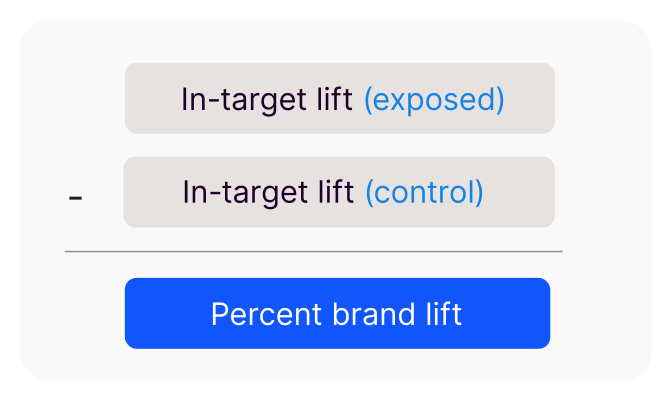
The challenge of calculating brand lift isn’t the math itself. It’s the recruitment of your exposed and control groups that can get complicated, especially when you want to cut your brand lift data to see how different demographic groups, device users, or media audiences respond to your ads.
Marketers, researchers, and analytics professionals will use a number of methodologies to recruit what a statistician would call a ‘stratified sample’ for a brand lift survey. The basic concept is the same: your study should recruit exposed and control respondents equally across the different audience groups — or strata — in order to ensure that your survey results provide meaningful insights about your campaign.
At Cint, we operate the largest global marketplace in market research, allowing us to recruit representative respondents anywhere a campaign is being run. Exposed respondents are measured via a combination of server-to-server data sharing, IP and MAID matching, metered panel data, and privacy-safe pixel tracking to identify whether or not someone has been exposed to an ad. We then recruit control respondents that are weighted according to the strata of the exposed respondents using the Raking method and use propensity scoring to minimize any differences between the control and exposed group, resulting in lift calculations that can be cut according to demographics, media type, creative, placement, and more.
Why cross-platform lift matters
Americans have never had more exposure to media than they do today. According to EMARKETER, the average individual in the United States spends 12 hours and 39 minutes per day consuming media. That media consumption translates to massive exposure opportunities for marketers, but only if you’re reaching users where they are. Just under half of that media consumption occurs on mobile devices, where media engagement is segmented across a widely diversified number of apps, games, and platforms that have come to be known as “walled gardens” for their notorious stubbornness to branch outside of themselves.
This presents a new problem for advertisers. Even Meta, the undisputed behemoth of American social media, only manages to hold 37 minutes of users’ attention per day, while at the same time claiming 72% of social media ad spend between Facebook and Instagram. How do you know that you are reaching your target audience when they’re actually engaging with the platform you’re advertising on?

The need to reach the right user at the right time explains the rapid growth in programmatic advertising in the last five years, with programmatic spending more than doubling since 2019 and expected to surpass $200 billion in media spend as of 2026. Programmatic advertising uses the data generated as part of every media interaction to make a split-second decision on whether this is the right person, at the right time, to see an ad.
That’s where cross-platform measurement comes in. We’ve created an ecosystem where ad placements are no longer a deliberate, fixed decision made by an advertiser, but the result of a highly efficient machine using terabytes of data to make real-time transactions. While advertisers may have removed themselves from the decision-making process of placing an ad, they are still accountable for how those ad dollars are actually spent. Brand lift measurement gives marketers a deterministic, compelling, and holistic way to prove that every dollar is well spent in the first year where the industry total ad spend is expected to exceed $1 trillion. Reaching our targeted audiences, generating engagement where we need it to, and creating a positive association with current and future customers of our brands is the ultimate goal.
About Lucid Measurement by Cint
Intro to Cint
Cint is one of the leading companies powering cross-platform measurement studies, utilizing the scale of our global programmatic research platform to help advertisers reach audiences that power our best-in-class brand lift solutions.
Our mission is to feed the world’s curiosity, and our platform achieves that by automating the insights-gathering process so companies can access survey data faster, with unparalleled scale.
About Lucid Measurement
Lucid Measurement by Cint is an always-on, cross-platform measurement product built to power easy-to-understand brand lift metrics for advertising campaigns and to allow media optimization while the campaign is in-flight. Lucid Measurement makes brand lift metrics easy to read and optimize for, with a user-friendly dashboard that is updated and stat-tested daily. It highlights key metrics and allows you to cut data across multiple demographic and media dimensions to find your story.
Trusted by companies like Disney Advertising, The Trade Desk, and more, countless brands and agencies look to Cint for holistic, actionable brand-lift insights that power some of the biggest campaigns in media.
Part 2
Best practices for cross-platform measurement
Our panel of experts break down some of the key strategies necessary to ensure accurate, actionable media measurement across all platforms.
Be clear about your campaign goals
The number one thing that all of our experts stressed was the importance of having a clear idea of what goals your measurement campaign is tracking. Brand awareness is only one of many metrics that can be tracked as part of a brand-lift study, with down funnel metrics like brand consideration or purchase intent frequently included among the KPIs that our clients include in their studies.
While this may seem trivial to anyone who’s familiar with a media campaign brief, it can also be remarkably hard not to give into the desire to have your campaign do all things at once. According to Cint SVP of Measurement Laura Manning, “If you’re running a really big brand awareness campaign at the Super Bowl, the top KPI on your study shouldn’t be purchase intent.”
Focusing your cross-platform study KPIs allows you more flexibility with your campaign learnings. Brand lift studies can highlight the leading indicators from an additional perspective, allowing businesses to gain new customers.
Tracking towards clear goals not only leads to more useful insights, but can also help you to make more meaningful optimizations while the campaign is live, as we’ll see later.
If you’re solely focused on the bottom of the funnel, you may not be able to understand what happened at the top or the mid-funnel that leads to a fluctuation in sales.
Make sure your media placements
are trackable
further key element of ensuring your measurement study is a success is making sure that you can actually and accurately track where your media is being placed. This is something that a lot of media buyers have expressed concern about as the industry shifts away from third-party cookies as opt-outs become more common on the most widely used browsers.
Fortunately, many measurement use cases continue to function in cookieless environments. Thanks to the increasing adoption of server-to-server tracking, universal identity solutions, first-party pixels, and data collaboration, measurement solutions like
Lucid Measurement are well positioned for a
cookieless future.
The key to success, then, is making sure that you have the sources of tracking that you need in place to track wherever your ad is going to run.
“It’s really important to set up your media tracking the way you want it to be measured.”

Laura Manning
SVP of Measurement, US, Cint
This may involve partnering with certain publishers or data vendors or even cutting your creatives in specific ways to ensure that you get the information you need to see what creatives, placements, and more are driving lift for your campaign. Many platforms are willing to accommodate these requests and will work with you to make sure that your tracking is working in a privacy-safe environment.
However, tracking is not without its logistical challenges. So-called ‘walled gardens’ can be particularly tricky to track, because by design their data is not shareable outside of the platform itself. In these cases, alternative methodologies like opportunity to see (OTS) can be useful to employ as a means of better understanding how walled garden platforms like social media stack up against the broader media mix and fit into the campaign plan. While the lack of deterministic data gives some advertisers pause, market researchers stress that OTS methodologies provide valuable insights for marketers.
Digital out-of-home (DOOH) can also be a challenging medium, according to Cint’s data science team. While you can use location data from someone’s mobile device to see if they were in the right place at the right time to notice an ad on a digital billboard, we can’t — unless we put a chip in their forehead, say — actually assess with 100% certainty that they looked at it.
Accounting for these difficulties and understanding how they contribute to a larger narrative around your media campaign can be just as important as tracking the numbers.
Understand what each platform in your media
mix adds to the campaign
“Effective cross-platform measurement has to take into account qualitative considerations of the media itself. Not just the data measured, but also the mindset of the user when they are consuming different types of media.” says Stephanie Gall, Director of Measurement and Data Product.
As with our DOOH example in the previous section, this means acknowledging that tracking can’t tell us everything about media consumption.
In truth, different forms of media serve different purposes to different individuals, and not all purposes are relevant to everyone.

You need to consider that because you’re trying to find the same user traveling through all these platforms, what you’re often actually seeing is cohorts of users who are in just one or two buckets. To really understand the cross-platform journey by a cohort of users, planning and scale are big factors when it comes to success.
It’s crucial to select partners and platforms that gel with your target audience. Who is most likely to be impacted by the campaign? Where do they consume their media?
Asking these questions can help you not only determine what creatives and placement to run in your campaign, but how to track your KPIs. For example, what does purchase consideration look like on a video ad versus a banner ad? You may want to set up your tracking to show you exposures during a certain quartile of a video where the product name and price are featured as opposed to counting any viewable impression.
Working with an experienced measurement professional can help you plan for all the scenarios that could affect the quality of your measurement insights, but it’s important to come to those conversations prepared to speak about the ideal user journey.
Ensure that you have enough impressions to draw meaningful insights
Scale has been a challenge for cross-platform brand lift measurement in a couple of different ways. “Traditionally, cross-platform studies have been costly, time consuming, and slow to get results,” says Laura Manning, a 10-year veteran of the field. “But in our current, very optimizable, very programmatic, very plugged-in ecosystem, very few people think it’s acceptable to wait until six weeks after your campaign ends to find out if it worked or didn’t work.”
Operationally speaking, “The more information we have the better we’re able to track your campaign’s performance across different platforms,” says Julia Reuther, Director of Product Success. “Having more cross-platform data is always going to improve confidence in brand lift.”
There are a few ways in which campaign scale
drives successful cross-platform measurement

Granularity of your cuts
“Scale ensures that the study can break down the interplay across platforms so that advertisers can see what was most impactful and that they can make decisions based on the results they see at a more granular level,” says Steph Gall.

Detail of your user journeys
As we go into multi-touch we’re realizing that users are more siloed than we’re accustomed to thinking of them. Maybe your scale of targeting is not broad enough to capture overlap. If you want to understand the journey across multiple platforms you need a lot of scale.

Size of effect
Statistical significance is often looked to as the holy grail of measurement, but it’s really only one of many metrics to consider when gauging success of a measurement study. What is the direction of your data? Does it remain stable over time? And what is the size of the effect? A 1% lift may not seem impressive, but 1% of 100 million impressions on Facebook is 1 million people. If a 1% purchase consideration lift translates 1 million people that could become customers of a business, that is a very meaningful insight.
Don’t be discouraged by negative lifts
It may come as a shock, but marketers are human beings, and like most human beings, marketers have a natural aversion to negative feedback. It doesn’t help that we often use brand lift as a means to justify the work we’ve done. Whether you are a platform value-adding a brand lift study to a multi-channel media buy or an agency selling a measurement study as a way to optimize budget across all of the channels on the media plan, negative lifts can feel like a risk. How do I report this back to my client? Will I lose this business if the lift is negative?
There are learnings to be taken from negatives. Maybe the campaign didn’t resonate because of the way the creative was run. Perhaps the
targeting didn’t reach enough of the audience that responds positively to your ad. What doesn’t work can always be turned into a positive: This is who you need to target, that is what will resonate in your next iteration.
Act upon your insights
That next iteration doesn’t have to wait until the campaign is over, either.
An effective cross-platform measurement strategy not only demonstrates that the campaign is achieving its goals but also enables optimizations. Whether it’s optimizing creative, frequency, or even publishers during the campaign, if an advertiser has a specific strategy and set objectives, it’s essential to target the individuals most likely to be impacted.
By ensuring that you are accurately measuring impressions, have sufficient scale to generate learnings, and have clear goals for your campaign, you can treat brand lift data like you would any other performance metrics – as a goal that’s achievable by pulling different levers in your campaign.
Download the Cross platform measurement guide