Finding the right balance between growth and high standards is an ongoing negotiation that requires curiosity, humility and industry collaboration, says Katy Mallios in an article for Research Live.
For as long as market research has existed, the industry has wrestled with a tension: the drive to scale versus the need for quality. Yet, the tighter we control inputs, the more we limit growth.
Today, that tension is sharper than ever. The globalisation of sample supply, automation of data collection and proliferation of marketplaces have made it easier to access respondents, but harder to ensure that what we collect truly reflects human insight. The challenge is not simply balancing scale and quality, but redefining what “responsible growth” looks like in a research economy built on volume.
Growth requires risk, but not recklessness
Every supplier, panel, or exchange faces a version of the same dilemma: growth demands experimentation. New recruitment sources, incentive models, and regional expansions are essential for reaching underrepresented audiences and meeting demand at speed.
When a supplier tests a new traffic source or onboarding mechanism, they are essentially making a bet, one that could unlock new, diverse respondents or introduce fraudulent behaviour.
In a healthy ecosystem, scaling supply doesn’t mean lowering standards. It means empowering suppliers to take calculated risks: expanding thoughtfully, monitoring quality in real time, and acting quickly when something goes wrong. That balance, between experimentation and control, is what separates sustainable growth from short-term gain.
Quality as shared accountability
Quality has too often been treated as a one-sided responsibility, owned by whoever purchases or fields the research. But in a connected marketplace, quality must be distributed across the chain: buyers, suppliers, technologists and researchers all play a role.
Fraud and data contamination aren’t isolated to bad actors; they emerge when oversight weakens or when incentives reward speed over signal integrity. A shared-accountability model acknowledges that quality management is an ecosystem function, not a single checkpoint. That collaboration can take many forms: shared dashboards, open feedback loops, security protocols that detect suspicious patterns, and early warning systems for anomalies. What matters is not the specific tool but the cultural shift it represents when quality becomes everyone’s concern, not just a back-end audit step.
Transparency as currency
Trust between buyers and suppliers is built on transparency, knowing where data originates, how respondents are treated, and what processes govern inclusion and exclusion.
Buyers often expect visibility into source composition or reconciliation rates, but suppliers rarely see equal visibility into study design or respondent experience. Both perspectives matter. A respondent’s willingness to participate in a survey is shaped not only by recruitment quality but also by what happens once they enter the survey environment.
Transparency, in this sense, is a two-way street. Suppliers deserve to know that surveys are fair, engaging and not overly repetitive. Buyers deserve to know that respondents are genuine, informed and consented.
“What matters is not the specific tool but the cultural shift it represents when quality becomes everyone’s concern, not just a back-end audit step.”
Katy Mallios SVP, Supply and Data Partnerships, Cint
Rethinking respondent experience
If the industry wants to preserve data integrity at scale, it must start with the respondent experience. Too often, participants are asked to answer the same demographic questions multiple times across systems. They face long surveys, redundant logic, or poorly optimised mobile interfaces, all of which erode attention and invite shortcuts.
Reducing that friction is not a small cosmetic fix; it’s foundational to quality. The next frontier of improvement may not be more verification, it may be simplification. Imagine an industry where researchers design with empathy for time and cognitive load. Where validation data can flow securely across systems, eliminating repetitive tasks. That’s not an efficiency play, it’s a quality one.
Technology can’t replace judgement
Machine learning and predictive scoring now underpin many quality-assurance systems, flagging anomalies and blocking low-integrity respondents before they enter surveys. These tools are critical, but not infallible.
Algorithms are only as good as their inputs, and even the best models can produce false positives, excluding legitimate respondents and biasing datasets. The future of data quality will depend on combining automation with human oversight, using machines for speed and scale, and people for context and correction. Balancing those forces is how the industry can evolve toward proactive, not punitive, quality management.
Toward a healthier marketplace
The push for growth isn’t going away. Demand for faster insights, broader representation, and continuous data will only accelerate, especially as the industry has entered the synthetic data era. The question is whether the infrastructure of research can evolve with equal sophistication.
A more resilient marketplace will rest on a few core principles:
Shared responsibility for data integrity across buyers and suppliers
Transparency that flows in both directions, illuminating processes and expectations
Empathy for the respondent journey, reducing friction and redundancy
Balanced automation, where people and machine intelligence complement each other.
Balancing scale and quality isn’t a zero-sum trade. It’s an ongoing negotiation, one that requires curiosity, humility, and collaboration across the industry. Rather than being about avoiding risk, responsible growth is about managing it wisely, with transparency as the connective tissue.
Collaboration will help shape Cint’s Model Context Protocol (MCP) capabilities, designed to connect AI agents directly with research and media intelligence workflows.
Cint’s Laura Manning, SVP, Global Measurement, speaks with The Drum alongside leaders from Roku and TripleLift on how marketers must move beyond vanity metrics and flawless frameworks to prove measurable outcomes to CFOs.
Esta alianza estratégica impulsará un enfoque unificado de medición de impacto de marca en toda Latinoamérica, brindando a los anunciantes, insights y métricas más rápidos y consistentes a través de las soluciones avanzadas de WPP Media, incluyendo Advanced TV, Advanced Video, Advanced Display, Advanced Audio y más.
Cint’s Chief Experience Officer, Michelle Darcy Clarke sat down with Toni Collis on the Leading Women in Tech podcast to reflect on her non-linear leadership careers, the VP comfort zone, and the mindset shift that separates people who grow from the ones who plateau.
Kate Crandall. Principal Product Manager, Cint, explores why outcomes measurement is no longer just a reporting function, but also a budget conversation in an article for ANA.
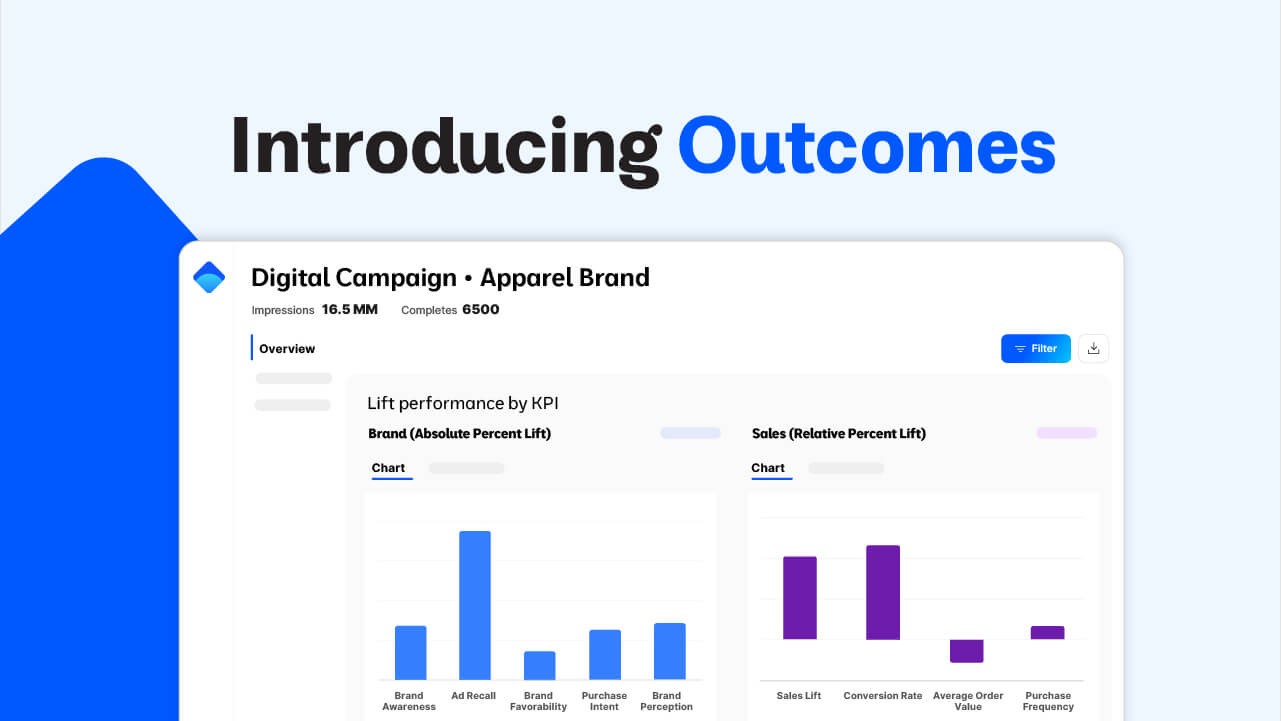
New capability connects brand lift and sales lift in one dashboard, helping advertisers optimize campaigns based on both consumer attitudes and purchase behavior while media is live
Basis is the First Advertising Management and Activation System to Offer Self-Serve Brand Lift Studies that Measure Awareness, Ad Recall, and Purchase Intent While Campaigns Are Live
New research finds streaming will outpace linear TV among U.S. World Cup viewers, while advertisers and sponsors face challenges turning visibility into consumer action
In a piece authored by Laura Manning, SVP of Measurement, CInt, she highlights a disconnect between what marketers measure and what executives need to inform future budget decisions.
Katie Ingram, Director, Advertising Week Europe, ties findings from Cint’s latest AI study to her take on what the rise of the ‘human premium’ means for brands and businesses.
The Wall Street Journal cites data from Cint’s latest report on AI in advertising, highlighting how marketers are addressing growing consumer skepticism by labeling content that does not use AI.
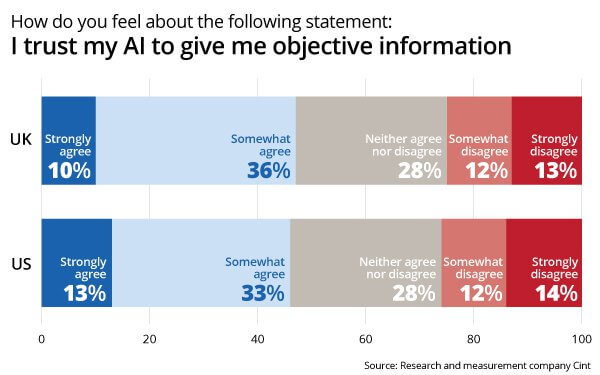
AI is moving too fast for some consumers, particularly when it comes to disclosure, trust, and brand perception, according to new Cint research, conducted in association with Advertising Week Europe.
Organisations need to think about fraud prevention and data quality standards not just as operational functions, but as organisational ones, writes Patrick Comer.
In an article for Greenbook, Marco Otero discusses why as AI and synthetic data scale research, human oversight remains essential to ensure data quality, trust, and credible decisions.
In an article for Greenbook, Cint’s Phil Ahad warns that brands are bypassing research due to speed, cost, and quality. Can the insights industry evolve fast enough?
AI Magazine’s Artificial Intelligence Industry Report features exclusive insights from leaders at 8 companies across different industries who are leading the charge with emerging technologies and growth strategies. Cint provides commentary as the featured company representing the Restech industry.
In an exclusive interview, Al Gaviria, Account Executive at Cint, analyzes the key moment in advertising measurement in Latin America: CTV, attention, brand lift, and why the market demands more than just impressions.
Cint’s Laura Manning highlights mid-flight decisioning as the new standard for campaign measurement in 2026. By using tighter feedback loops and reliable signals to optimize campaigns in real-time, brands can finally tie early exposure to long-term loyalty.
Finding the right balance between growth and high standards is an ongoing negotiation that requires curiosity, humility and industry collaboration, says Katy Mallios in an article for Research Live.
Cint selects Rep Data’s Research Defender as an ongoing quality technology partner, while Rep Data expands its sample partnership with Cint to strengthen global reach and collaboration
Proactive, cross-functional fraud prevention is essential in today’s research ecosystem. The right people, tools and culture can prevent wasted budgets, reputational damage and flawed business decisions.
Cint Launches “Luci,” an AI Study Companion for Real-Time Brand Lift Insights: New AI-powered feature in Lucid Measurement makes campaign optimization faster, smarter, and more intuitive
James Snyder, Vice President of Trust and Safety at Cint, shares his expert perspective on the quiet blurring of the line between real and synthetic input in a recent article. Originally published in Research Live, the piece features Snyder’s argument that this change challenges our understanding of what data quality means.
Kantar has strengthened its partnership with Cint, tapping into the new Cint Exchange to gain unprecedented access to a vast network of global insights.
In an article for Greenbook, Lindsay Fordham discusses how AI is redefining market research—ushering in an intelligence era focused on high-quality insights, scalable rigor, and trusted data-driven decisions.
As industries across marketing, media, product development and beyond shift toward faster, more iterative workflows, Cint CEO Patrick Comer unpacks the future of Restech.
Cint has become certified as a Most Loved Workplace® backed by the research and analysis of Best Practice Institute (BPI) and named in the top 50 of Newsweek’s 2025 Global Top 100 Most Loved Workplaces® list.
Cint polls consumer confidence and releases Upfronts Report on TV viewership habits to help advertisers assess budgets and campaign planning during Upfronts season
Cint, the leader in research technology (Restech), is excited to announce a reimagined brand and the latest release of its new research platform, the Cint Exchange.
Cint, the global leader in market research technology (Restech), is pleased to announce two key promotions from its Global Leadership Team (GLT) into the C-Suite, further solidifying the company’s commitment to customer experience and its three-year strategy.
Cint, a pioneer in research technology and digital insights, today released findings from ‘The State of Data Collaboration: A Global Perspective’, a joint report on marketer and agency challenges in association with data collaboration innovator, Lotame.
To support privacy-conscious ad exposure and diversify available identity solutions for brand-lift measurement, Cint is excited to enable Unified ID 2.0 (UID2) for Lucid Measurement on UID2-supported demand-side platforms like The Trade Desk.
The partnership allows Conjointly and Cint to directly connect via a server-to-server integration, effectively eliminating “ghost completes” – a form of fraudulent survey responses.
Cint scoops second prize for its achievements in data quality with ground-breaking Forsta partnership on a secure server-to-server (S2S) API integration.
Cint and Advertising Week partnered to explore the impact of deepfakes, AI and social media on upcoming elections globally. The findings – as revealed live at Advertising Week EU – were covered by Stylist.
GapFish GmbH, a Berlin-based market research company that was acquired by the Cint Group in 2021 will in early April 2024 merge with Cint Deutschland GmbH.
Cint and JTB Tourism Research & Consulting Co. jointly conducted a survey on changes in inbound traveler behavior and attitudes toward sustainable tourism
Lucid Impact Measurement by Cint is poised to change the game in an era where a patchwork of brand lift studies from multiple social platforms with differing, non-comparable methodologies is needed to gauge campaign effectiveness.
Lucid, a Cint Group Company is now an Amazon Ads verified partner. Advertisers on the Amazon DSP can use Lucid Impact Measurement to automatically measure brand lift from their campaigns.
Vanessa brings more than 20 years of experience to the Cint team, leading and collaborating across local and global companies to develop and scale in measurement, data, and technology centric solutions. In a time where every ad dollar counts and campaign measurement is critical, Vanessa’s expertise aids in accelerating growth and opportunities for brands.
Our new partnership with StatSocial means that insights professionals can tap into the power of both our platforms to target niche market research audiences, quickly and at scale.