
Introduction
We’re living through an era where research and marketing budgets are being tightened, concerns around survey data quality are widespread, and more and more companies are making the move to collect their own first-party data.
With that in mind, is survey data still a necessity when it comes to keeping consumers at the heart of innovation?
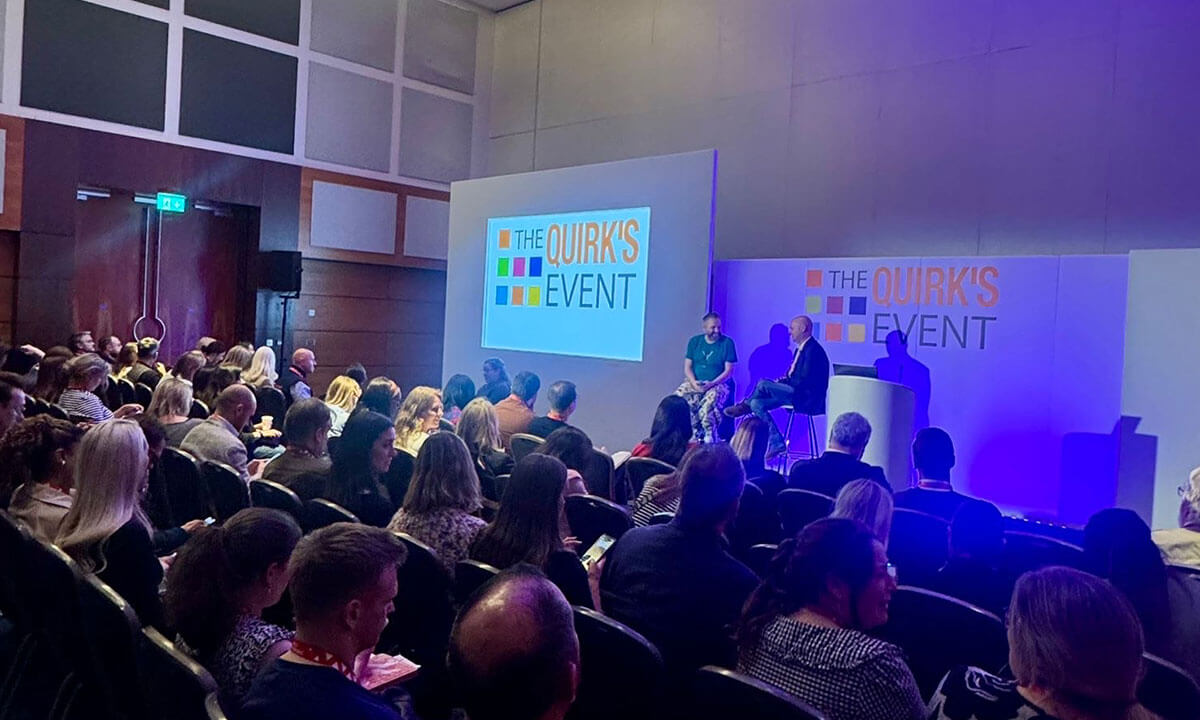
That was the question that Cint’s Wilson Peters (VP, Global Customer Success) and Delineate’s James ‘JT’ Turner (Founder and CEO) discussed recently at Quirk’s New York 2025.
Coming hot on the heels of the announcement that Cint and Delineate have renewed their partnership to power real-time brand and campaign tracking across the globe, it was the perfect time for the two to take to the stage.
If you weren’t lucky enough to be in attendance at the event, we’ve got you covered with this recap of why conducting consumer research is arguably more important than ever for brands who are looking to connect directly with consumers and leveraging key learnings to inform impactful campaigns.
Fit for purpose?
The duo began their session by discussing the necessity of ensuring that your research is genuinely fit for purpose. After all, ensuring that research is seen as a strategic driver of growth rather than a commodity is at the heart of what many marketers do day in, day out.
To road to beneficial, actionable insights begins with solid survey design. Turner defined a “fit for purpose” study as one where the data gathered drives the ability to answer specific business questions with both thought and precision.
It’s an approach that requires a lot of honing and redrafting but eventually allows for greater control over the survey in question.
Turner noted that, “The value for me is that you can be quite clear about the context within which you are asking respondents about particular issues.”
That contextual clarity enables researchers to explore topics not widely discussed on social media or other online sources, because while it might feel like everyone is out there chatting about every topic under the sun, it is worth bearing in mind that this isn’t quite the case.
“People don’t talk about everything online,” Turner said.
Peters added that, “If you want insightful, thoughtful, customer data,” you need to design an experience that works for the respondent. “We need to think about the time they are committing, the quality answers we’re asking for, the compensation they’re getting at the end of the day.”
Want a survey that leads to something and keeps the consumer in mind? Make sure it’s fit for purpose.
Minding the gap
One of the perpetual pleasures of market research is its ability to shine a light on the previously unknown, and solid research allows us to identify blindspots we may have otherwise missed.
The question everyone should be asking, then, is how do you go about figuring out what it is that you don’t know?
It’s a thorny problem made even thornier by recent advances powering the mechanics of market research. With AI continuing to be a hot topic, and a shift toward experimenting with synthetic data, there’s the potential risk of tech doing all the talking, leaving the consumer in the dark.
“When you start to look at the consumer through the lens of the science team, we’ve seen examples where they’re not consumer-centric,” said Turner. “They are quite blind to some of the things that their data sources aren’t picking up.”
The good news, according to Turner, is that “researchers have always, in my opinion, been good at thinking about those blind spots, thinking about hypotheses, thinking about testing whether what we put in is true.”
“There’s a question people in so many fields are asking: Is AI going to work me out of a job? For researchers, the answer is an emphatic no. But, a person using AI might. AI can help cut and sort a lot of insights, quickly.”

Wilson Peters
VP, Global Customer Success, Cint
Peters was also keen to stress that embracing AI isn’t a disadvantage for researchers. “There’s a question people in so many fields are asking: Is AI going to work me out of a job? For researchers, the answer is an emphatic no. But, a person using AI might. AI can help cut and sort a lot of insights, quickly. It can act as a massive time saver and help uncover patterns that would have been easy to miss. And it can help generalize those insights to paint a pretty good picture for your customers. But, then it comes back to the researcher to analyze — and contextualize — those insights through a human understanding of the human experience.”
Conducting regular real-time survey research helps bridge the gap between the known and the unknown by providing external validation and calibration, enabling researchers to describe features in the data that they were not getting elsewhere.
Doing so can act as a crucial check on models and analytics, ensuring they remain grounded in real-world understanding.
“Think of research as a really great way of understanding the world around us, which it always has been,” Turner said.
Looking through the human lens
Being customer-centric means remembering a simple, but vitally important, fact: your customers are human beings.
Human-driven segmentations remain crucial for businesses as they attempt to understand audiences, and while models can be trained on synthetic audiences, survey data retains a major role in providing genuine human feedback to uncover human truths.
First-party data provides organisations with crucial insights about the individual consumer, their work, their family, their life, their wants, desires and their behaviors
“It comes back to the fundamental point that researchers are trying to cover human truths, I keep coming back to that in a world where we’re looking at synthetic data to make decisions — where is the human in it and how do you prove it’s right?”

James ‘JT’ Turner
Founder and CEO, Delinate
“It comes back to the fundamental point that researchers are trying to cover human truths,” Turner said. “I keep coming back to that in a world where we’re looking at synthetic data to make decisions — where is the human in it and how do you prove it’s right?”
As he puts it, “There will always be a need for organic human interaction with thoughtful design.”
Connect with Cint today
Keen to learn more about how working with Cint could help you get closer to your consumers? Head here to discover the benefits of the Cint Exchange, the world’s largest programmatic research marketplace.