
Contents
- Confronting the problem of bias in market research (and beyond)
- What is sampling bias?
- Why is sample bias an issue in market research?
- What are some common examples of sample bias?
- How can working with a marketplace rather than single suppliers mitigate sampling bias?
- Learn more about Cint’s approach to meaningful market research
Categories
Confronting the problem of bias in market research (and beyond)
Bias is an inescapable part of being human; each of us sees and interprets the world differently, and those points of difference form a complex web of unconscious biases. In the market research industry, bias has consequences for researchers and consumers alike.
Biases can add to the cost of conducting research, lead to incorrect conclusions and decisions, and veer researchers away from what they need most: the ability to accurately create targeting criteria that ensures studies are being completed by representative segments of a target population.
What is sampling bias?
Sampling bias is the name given to a situation where a group of participants in a study — or respondents of a survey — does not accurately reflect the characteristics of the entire population being analyzed.
Sample bias occurs when some individuals are more or less likely to be selected as respondents than others, for a myriad of reasons. The result is data that is biased toward specific traits or groups, rather than providing a more objective understanding of the wider population.
We might think of this kind of sample as being skewed, and if you’re working with a skewed sample, you’ll find yourself with skewed insights.
Why is sample bias an issue in market research?
Biased sample compromises the representativeness of research. If certain segments of a population are under or overrepresented, you’re left with data that doesn’t truly reflect reality.
For research professionals this has consequences, including the potential for flawed conclusions and, as a result, possibly misinformed strategic decision-making.
By rendering findings unreliable or skewed, sampling bias turns what should be data-driven insights into something less useful for researchers and wider organizations. In a period when budgets are stretched and there’s a need for researchers to shift the perspective of market research from being seen as a commodity into a strategic driver of growth, bias is a massive problem.
In addition to the issues it causes for representation, reliability, and rigorous decision-making, biased sample can also pose problems regarding ethics and reputation.
What are some common examples of sample bias?
Just as it does in our broader experiences of the world, bias in market research comes in many forms. Some of the most common of these are:
- Voluntary response bias or self-selection bias: This type of bias occurs when participants self-select into a study. Due to the fact that there will be prior motivations behind a respondent opting-in, it can be assumed that the resulting data may only extoll specific points of view, leading to skewed insights.
- Survivorship bias: This is a kind of bias that can happen when your sample is over-focused on those who pass the selection criteria assigned to respondents ahead of participating in a survey.
- Undercoverage bias: Otherwise known as exclusion bias, undercoverage bias happens when your sampling method systematically excludes specific groups, leading to results that don’t accurately reflect the population as a whole.
- Non-response bias: As the name suggests, non-response bias is what may happen when a sub-group of respondents say no to participating in studies, or drop out of surveys mid-completion. Non-response biases may be grounded in poor survey design. Learn more about successful survey design here.
- Convenience sampling: Using easy to reach respondents for your surveys has the potential to build in convenience sampling bias into your research.
How can working with a marketplace rather than single suppliers mitigate sampling bias?
As we’ve previously established, different suppliers will approach respondent recruitment differently, resulting in demographic, behavioural, or attitudinal biases.
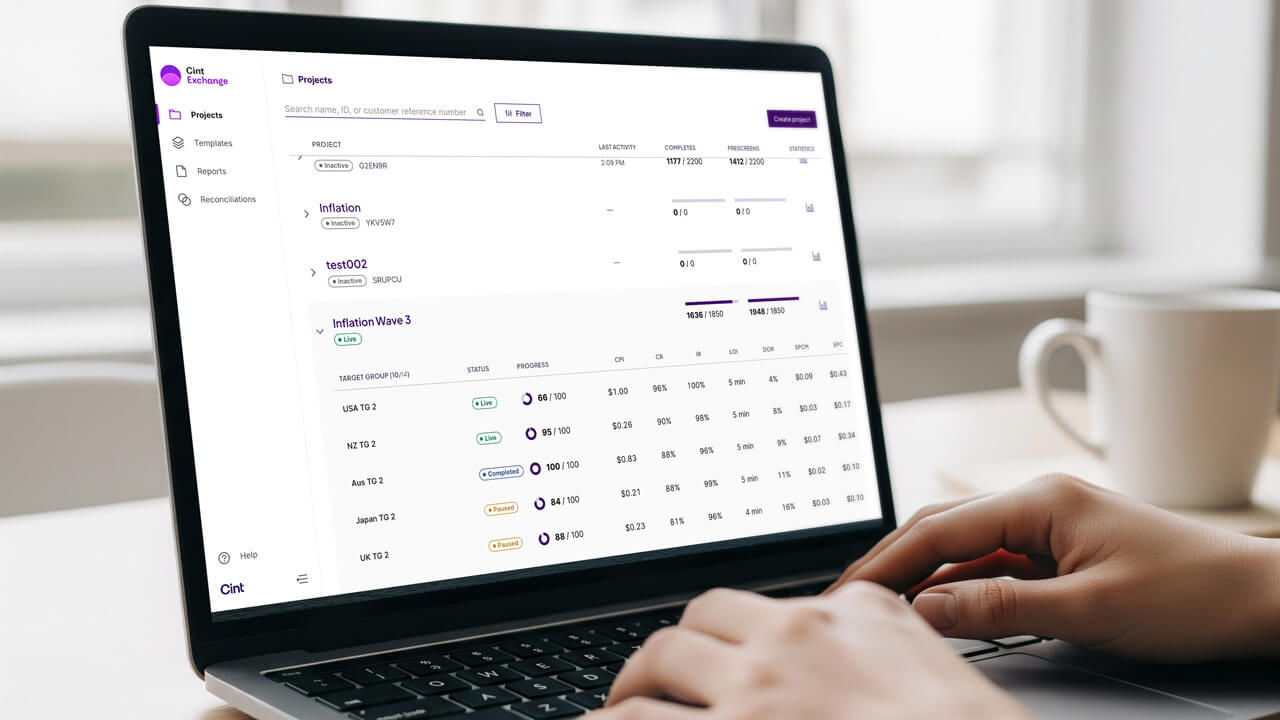
The Cint Exchange — the world’s largest online research marketplace —neutralizes those potential biases by bringing the world’s largest selection of suppliers to a single platform and enabling researchers to select the suppliers they would like to work with in just a few clicks.
Utilizing the Cint Exchange to work with multiple suppliers ensures that researchers can be confident that biases will be mitigated as much as possible.

Utilizing the Cint Exchange to work with multiple suppliers ensures that researchers can be confident that biases will be mitigated as much as possible. As a result, researchers can access high-quality, meaningful insights to fuel data-led decisions.
Learn more about Cint’s approach to meaningful market research
Considering moving your research methods to a consolidated and truly global marketplace? Get in touch with us today and start your journey with Cint.