Contents
- Have consumers actually seen ads in AI chat tools?
- Where consumers say they’re encountering AI ads
- Does advertising change trust in an AI assistant?
- Are AI chat ads viewed as useful or relevant?
- Would consumers rather see ads or pay to remove them?
- What this means for brands experimenting in AI chat environments
- Learn more about Lucid Measurement
Categories
Have consumers actually seen ads in AI chat tools?
In recent years, workforces across the globe have assimilated AI chat and assistant tools into their 9-5s. As such services become increasingly prevalent in the office, monetization is no longer a purely theoretical question.
What, though, does advertising look like in the context of products that are built on guidance, answers, and (ideally) trust?
New research conducted through Cint Snap — our way of surveying individuals to gather insights quickly — suggests that consumers believe they’re already seeing it.
In our survey of U.S. consumers, 49% say they’ve seen advertising or branded content in an AI chat or assistant platform. This contrasts with 38% who say they have not seen material of this kind, and the remaining 13% who aren’t sure.
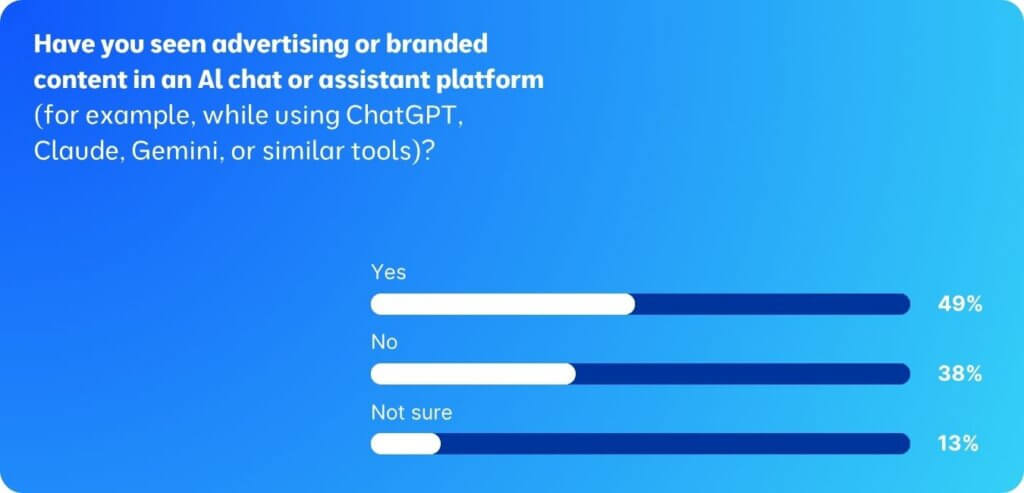
That’s an important split for platforms and advertisers alike: whether these placements are formal ad units, sponsored responses, branded content, or simply something that consumers interpret as a form of advertising, we can see that consumers are starting to notice branded influence within AI experiences.
Where consumers say they’re encountering AI ads
The contemporary consumer isn’t experiencing “AI advertising” in one particular place: they’re encountering it across different surfaces that are now AI-enabled, like social feeds or search-like experiences.
When asked where they’ve seen advertising or branded content in an AI environment, social media posts about AI tools (45%), AI chat assistants (39%) and AI-powered search results (27%) were the top responses.
The data demonstrates that AI ads aren’t confined to the chat window. The consumer perception of “AI advertising” is broader, and likely to expand as more platforms blend AI into their discovery, recommendations, and search tools.
Does advertising change trust in an AI assistant?
AI assistants occupy a different role than most ad-supported environments. In recent years, we’ve seen an uptick in people using assistants of this kind for advice, planning, and decision support. Those use cases make trust a core feature, not a nice-to-have.
When asked if seeing advertising in an AI assistant changes how much they trust the platform, opinions were mixed. A quarter said they’d trust it somewhat less, with a further 14% saying they’d trust it much less. On the other end of the spectrum, we had a combined 20% who trusted the platform in question somewhat or much more as a result of being presented with ads in this context. That left us with the remaining 41% of respondents who wouldn’t have their trust levels impacted either way.
For platforms, these data points reinforce the importance of clarity around what is sponsored. For brands, they’re a reminder that the environment matters as much as the message.
Are AI chat ads viewed as useful or relevant?
Consumer openness comes down to one crucial thing: whether advertising actually feels helpful in context.
When asked how relevant or useful ads inside an AI chat platform would be, 35% of respondents consider them to be moderately relevant or useful, a fifth think they’re slightly relevant or useful, 14% believe them to be very relevant or useful, and for 8%, ads of this kind are considered to be extremely relevant or useful.
On the other hand, we have nearly a quarter (23%) of consumers who stated that they are not at all relevant or useful.
For brands, this potentially suggests an opportunity, but one with constraints. AI chat products are a high-intent environment, and consumers can see the use in these kinds of ads, but brands need to be wary of execution that feels interruptive or misaligned with the conversations that users are having.
Would consumers rather see ads or pay to remove them?
As platforms plough on with testing monetization models, we wanted to understand what consumers actually prefer when using AI chat tools and assistants.
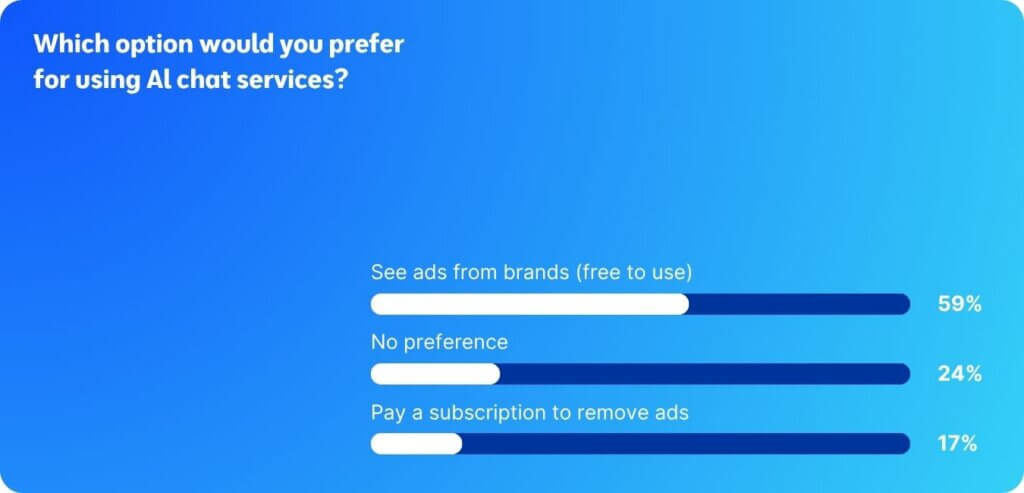
A sizable 59% of consumers surveyed would be happy to see ads in products of this kind, provided that doing so kept them free to use. This is in contrast to the 17% of respondents who stated that they would rather pay a subscription that removes ads from a service of this kind. Just under a quarter (24%) currently have no preference either way.
Arguably, our data shows a meaningful willingness on the part of consumers to accept advertising in exchange for free access, but this doesn’t automatically equate to advertising driving positive outcomes for brands.
With that in mind, we surveyed respondents about the impact of ads in AI chat tools on brand favorability. For our audience at least, an air of indifference hangs over the question: just under half (44%) of consumers stated that there’d be no change on the favorability front. We also saw that the combined 27% who would feel more favorable toward the brand are effectively balanced by the combined 29% who would lean the other way.
Ads of this kind don’t seem to be moving the needle when it comes to shifting consumers from viewers to buyers: 41% of respondents are neither likely nor unlikely to make a purchase having seen an ad in an AI chat tool or assistant. This leaves the remaining audience split between a 32% positive outlook and a 27% negative one.
What this means for brands experimenting in AI chat environments
For advertisers, AI chat is emerging as a new type of placement, closer to decision support than traditional interruption-based ads. This data suggests three practical considerations:
Lead with relevance: Consumers are most open when the ad feels directly connected to what they’re trying to do.
Prioritize transparency: The trust cost of unclear sponsorship may be higher in AI chat than in other channels.
Test and measure early: The audience is not uniform: a significant share sees no impact, but a meaningful group becomes less trusting or less favorable.
Learn more about Lucid Measurement
Want to know more about how you can optimize lift results for your campaigns through Lucid Measurement in the age of AI ads? Get in touch with Cint today.