
What is brand lift?
The focus of brand lift studies is to measure the effectiveness of advertising campaigns. For people working with, for, or on the behalf of brands, studies of this kind help you understand how specific ad campaigns impact consumers’ perceptions of the brand in question.
Brand lift studies measure perception in the moment, providing you with qualitative and quantitative insights that may form part of in-flight decision making.
When it comes to studying ad recall and brand lift measurement, the word “lift” refers to incremental increases in a variety of key performance indicators (KPIs) that occur due to exposure to an ad.
They’re a crucial part of any media measurement, analytics, or research professional’s toolbox.
Brand lift KPIs are typically measured within an exposed vs. un-exposed context to isolate the impact of the campaign in review.
What brand lift metrics should I be measuring?
Understanding brand lift results is central for anyone looking to optimize their advertising strategy.
You’ve gotten the results of your brand lift study back. Now what? This resource can be used to help you further analyze the results of your brand lift study
Here’s how to define and interpret KPIs based on your lift study results.
Evaluating statistical significance
When we run an ad campaign and see a “lift”, meaning, for example, more people remember our ad, we need to know if that improvement is genuinely because of our ad, or just a fluke. This is where “statistical significance” comes in.
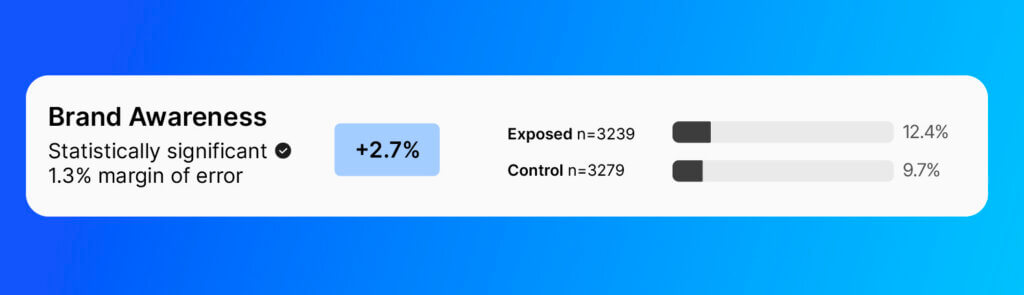
Think of it like this: if we say a result is “statistically significant” (usually if something called a “p-value” is less than 0.05, or we have a 90-95% “confidence level”), it means we’re very confident the result isn’t just random luck. If the exact same study was run 100 times, we’d expect to see similar results about 90 to 95 of those times. So, it’s highly unlikely the positive outcome happened by pure chance.
Sometimes, even if an ad did have an impact, the brand lift study might not show it as “significant.” This may be a result of there being too small a sample size.
Additionally, if the results between the group that saw the ad and the group that didn’t are very similar (meaning very little lift), it might mean a much larger sample is needed to confidently say whether the ad had any real effect.
Identifying trends across KPIs
By carefully examining the relationships between different KPIs, marketers can gain a clearer understanding of their campaign’s strengths and weaknesses — even while it is in-flight
For instance, if your ad recall lift is strong but your brand consideration lift is low, it may signal a critical disconnect. Your ad might be memorable but it isn’t effectively convincing people to actually consider your brand for purchase.
Similarly, a low message association lift indicates that while people might remember the ad itself, they aren’t connecting its core messages or unique selling points directly back to your brand. The message might be clear, but it is possible that the link to your product or service isn’t sticking.
Finally, if your brand attribute lift shows inconsistent results, perhaps improving one desired perception but not others, or even negatively impacting some, it highlights a need to refine your creative strategy. Your ad might be sending mixed signals or failing to consistently reinforce the specific brand qualities you aim to convey.
Benchmarking lift results
To keep on top of things try comparing your brand lift performance against:
- Industry benchmarks
- Your past campaigns (to track improvements over time)
- Competitor insights
If things look like they need improvement, focus on the following areas:
Analyze feedback: Use surveys, focus groups, or A/B testing to identify what went wrong with the ad.
Refine targeting: Ensure the ad reaches the right audience by leveraging data analytics and segmentation.
Improve creative quality: Test different ad formats and messaging styles to find what resonates.
Optimize frequency: Control ad exposure to prevent fatigue.
Monitor brand sentiment: Track online reviews, social media, and PR to address broader reputation issues.
Use contextual targeting: Place ads alongside content that aligns with the brand’s image and values.
Learn more
Want to know more about how you can optimize lift results for your campaigns through Lucid Measurement? Get in touch with Cint today.