How AI is driving a permanent evolution in market research
At SampleCon 2026, Cint CEO Patrick Comer took to the stage to address the industry regarding the transformations currently reshaping the world of market research.
But – to make for a thought-provoking kickoff to the event – he was given a specific directive for his dissertation: In an era where AI is the key driver behind reshaping the research industry, Comer was tasked with making a strong argument for a future in which synthetic sampling replaces human-only sampling.
To provide the opposite perspective, Melanie Courtright, CSO at SAGO, took the stage arguing why human-only sample should remain the norm.
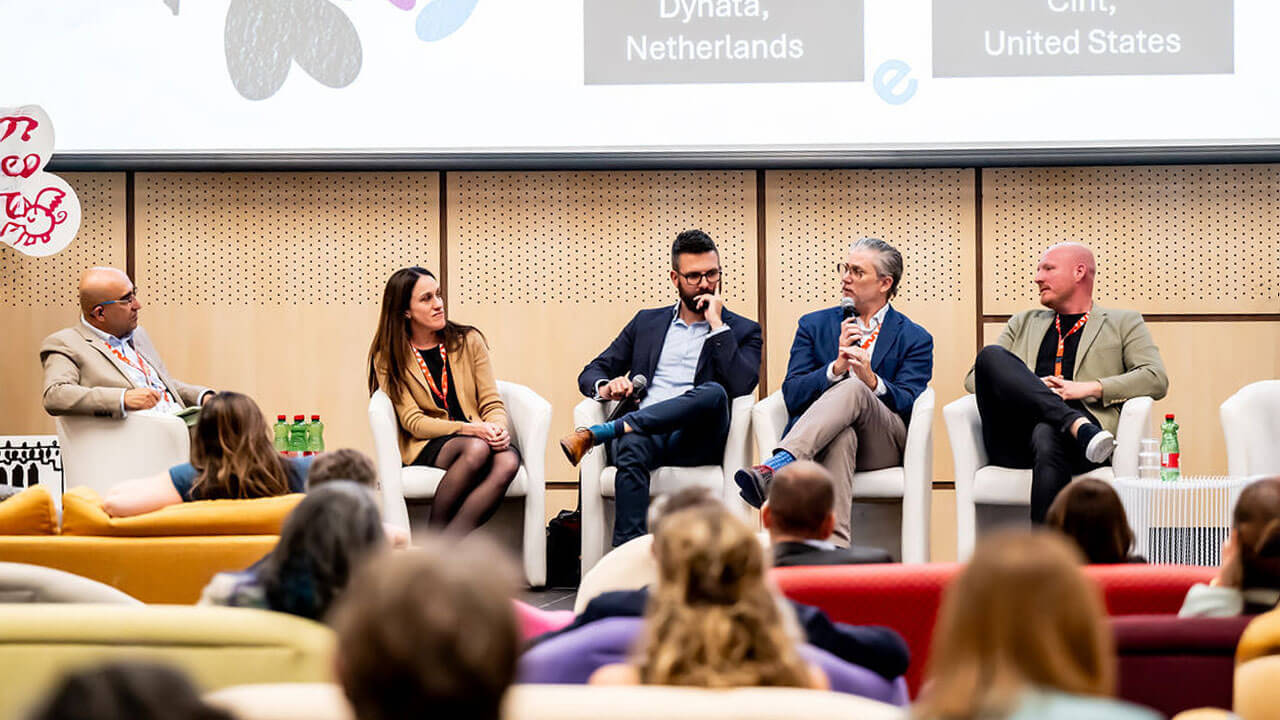
Following each one-sided presentation, the two debated the topic, underscoring the challenge the research industry faces as we navigate what a hybrid future looks like – and which scenarios should remain human-only compared to where augmenting with synthetic sample is the way forward.
Comer’s talk zoomed in on the industry’s transition from human-only sampling toward a future defined by synthetic scale. As AI adoption moves at twice the speed of the previous shift from phone to online surveys, Comer highlighted that the primary expectation for data collection is undergoing a permanent evolution.
“This is the last time that we’ll meet with the expectation that the primary thing that we sell and operate is human-based sampling,” Comer said by way of introduction. “This is the last time we’ll sit in these chairs and quietly assume that everything we do is about human people answering questions for surveys.”
Read on to learn more about why everything we thought we knew about survey sampling is changing, and why Cint is at the forefront of a research revolution.
The journey from phone calls to AI-powered research
Market research hasn’t remained static, and the rise of synthetic sample isn’t the first major technological shift the field has had to adapt to.
Difficult as it may be to remember now, there was a time when the bulk of surveys took place over the phone. In the early 2000s, something shifted.
“All the surveys were done by phone, and people like me who were in their 20s at the time decided that it’d be cool to do online surveys. It was a novelty, and no one believed that online surveys would outpace those done through the phone,” Comer said.
By 2008 or so, the naysayers had been proved wrong: the number of surveys conducted online had eclipsed the number of phone surveys.
“The reason for this transition wasn’t just about cost. It wasn’t just about speed. It was that the industry of insights shifted to a higher scale. Meaning that the types of insights that were possible online were bigger, broader, and faster than what was possible on the phone,” he said. “Therefore, the types of research companies that were developed and grown started to believe in bigger insights, bigger data, that were not possible on the phone.”
Human seed data, synthetic scale
While it took around 10 years for online surveys to supplant traditional, phone-based methodologies, Comer proposed a scenario in which our current revolution will happen a lot faster.
“We’re at the very beginning of the exponential curve. Let’s assume it’s twice as fast as the online adoption curve. So by 2030, five years from today, synthetic completes could outpace online.”
Patrick Comer CEO, Cint
“We’re at the very beginning of the exponential curve. Let’s assume it’s twice as fast as the online adoption curve. So by 2030, five years from today, synthetic completes could outpace online.”
However, the use of AI and synthetic data doesn’t sound the death knell for human-led market research. As Comer put it, “I’m not saying that humans will stop mattering. I’m saying that humans are the bottleneck of AI data collection. That the amount of data that we’re going to want to collect in research on a go-forward basis is going to be larger than if a panel could include every single human on the planet.”
As we’ve previously discussed at Cint, high-quality human responses provide the essential foundation upon which massive synthetic datasets are built. “Our foundation is the people that we all work with every day in panels: that’s not going away,” Comer said. “But the scale problem is getting to trillions of data points, with instant turnaround, and populations that don’t even exist yet in the panels that we run. Human data is the seed; synthetic is the scale.”
There’s no Rosetta Stone for market research
The research industry’s desire to find a perfect validation match between human and synthetic data is a familiar one. Comer compared the search to the early days of online research, when practitioners desperately sought a “Rosetta Stone” to prove that web-based results were identical to phone surveys. That document never arrived because the methodologies were fundamentally different.
“If you keep trying to find it, you’re barking up the wrong tree. Stop trying to make it equivalent. It’s never going to be. It’s something different. It’s bigger. It’s AI,” said Comer.
Instead of trying to force equivalence between two distinct processes, the focus must shift toward innovation. Waiting for a definitive proof of alignment only delays progress and risks obsolescence.
Comer warned that “the ones who are waiting for a Rosetta Stone to find a way to bridge the two are going to be remembered more like the phone companies.” To avoid this fate, the industry needs to move past legacy benchmarks and embrace new methodologies designed for a synthetic-first era. By prioritizing speed and scale over a search for identicality, researchers can finally unlock the true potential of AI-driven insights.
Get in touch today
Want to know more about how you can unlock additional value from your research data?
Discover how MCP enables marketing teams to query real-time brand lift, performance metrics, and campaign outcomes through simple natural language prompts.
As AI fraud rings threaten market research, validated synthetic data offers a defense. Discover how to protect data integrity from automated deception and preserve trust.
Understand what first-party data is, why it’s crucial for a modern data strategy, and how you can effectively collect, manage, and enrich it for insights.
Get the low down on what Cint CEO Patrick Comer and VP of Trust and Safety Jimmy Snyder had to say about combating fraud while protecting the respondent experience.
Learn how to calculate and measure ad recall, brand awareness, consideration, message association, and brand attribute lift to optimize your ad campaigns.
Learn how reliable, accurate survey data leads to stronger decision-making, better targeting, and optimized resource allocation for effective insights.
Cint’s Wilson Peters (VP, Global Customer Success) and Delineate’s James ‘JT’ Turner (Founder and CEO) discuss the importance of research when it comes to connecting with consumers.
Explore how survey design, inclusive language, and community engagement can help us create research that reflects the full diversity of human experience.
Director of Product Management at Cint, Stephanie Gall, joined the EMARKETER podcast to discuss how to make better campaign decisions in periods of flux.
Feeling the pinch but still need to deliver? A panel of experts headed by Cint’s Laura Manning discuss strategic approaches to media measurement during a period of flux.