
Getting to the (human) heart of the data
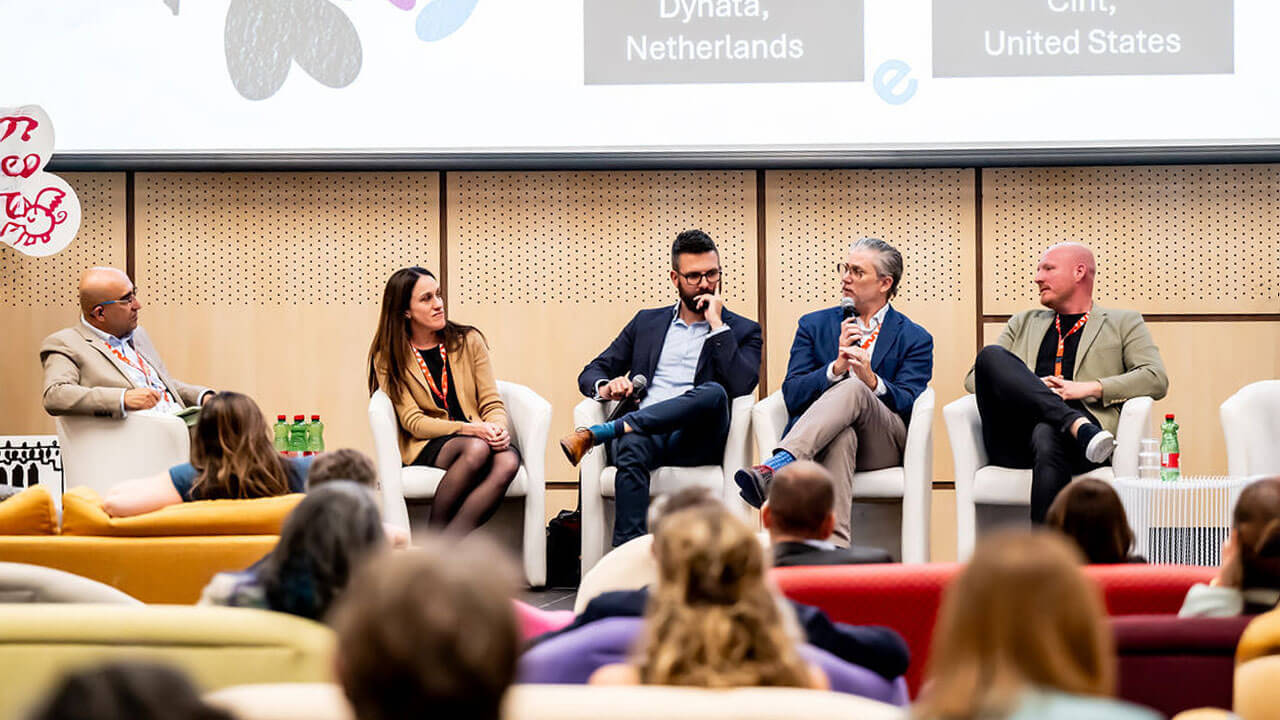
Cint’s VP of Trust and Safety, Jimmy Snyder, recently took to the stage in Tokyo at ESOMAR APAC to deliver a talk entitled ‘The Heart Of The Data: Reclaiming the Respondent Experience.’
Snyder, who oversees Cint’s operational Trust and Safety teams, is fully focused on creating and administering quality-related programs, products, and policies dedicated to ensuring a healthy and efficient ecosystem.
As part of the conference’s overarching theme of empathy, Snyder’s session explored how to keep the respondent experience as strong, humane, and as top of mind as it can possibly be in a period of increased usage of AI and automation across the entire market research ecosystem.
Read on to find out why reclaiming that empathetic experience is a necessity.
The hidden cost of building digital fortresses
“We often talk about ‘data points,’ ‘incidence rates,’ and ‘feasibility.’ We look at dashboards filled with percentages and trend lines. But today, I want to talk about what, or rather, who sits behind every single one of those numbers,” said Snyder.
Anyone involved in market research will attest to the fact that we’re in the midst of a technological revolution. The rise of generative AI as a means of automating previously time-consuming research tasks has changed the game for everyone; data is now available at speeds that were previously unthinkable.
This technological revolution has also brought a shadow. The unintended consequences of increased automation include a flood of synthetic data, bot farms, and more sophisticated fraud than ever before. In our industry-wide scramble to protect our data integrity, we have, as Snyder puts it, “built digital fortresses.”
In our attempt to lock out the bots that continue to cause huge problems for the industry, many of the protective measures that have been put in place are accidentally locking out the humans.
“Today, I want to advocate for the lifeblood of our industry: the respondent,” Snyder said. “It’s time to realize that we need to shift our focus from “verification at all costs” to “empathy by design.”
Forgoing respondent friction
Building on this theme, Snyder talked the audience through an all too familiar online occurrence: the slightly wonky CAPTCHA test.
“Think about the last time you tried to log into a website and were asked to click on every chimney in a blurry photo, only to be told you missed one. Then you were asked to identify motorcycles. By the third attempt, your blood pressure was rising.”

“Think about the last time you tried to log into a website and were asked to click on every chimney in a blurry photo, only to be told you missed one. Then you were asked to identify motorcycles. By the third attempt, your blood pressure was rising.”
This wasn’t just an individual airing their grievances: To combat automated threats, many data collection platforms and research marketplaces have implemented aggressive security layers in their ongoing attempt to tackle fraud and uphold data quality standards.
Survey respondents often find themselves hit with three rounds of Captchas, “digital fingerprinting” delays, and repetitive screenings that ask them for their age and zip code for the fifth time this week.
“When we treat every human as a potential criminal until proven otherwise, we shouldn’t be surprised when they stop showing up,” stated Snyder. “Friction is a tax on human patience. If the experience of giving us data is painful, the only people left willing to endure it will be those who have no other choice or the bots specifically programmed to bypass our hurdles.”
Moving away from invasive tracking toward predictive modelling
Continuing the AI theme, Snyder asserted that it should be seen as a series of tools, not an invitation or excuse to be invasive. AI can and should be leveraged in order to detect patterns of fraud and protect the research ecosystem, but it should simultaneously be a means of making life easier for respondents.
“Many companies are asking someone twenty demographic questions that they’ve already answered in their panel profile. Many are using invasive tracking when we could be using smart, predictive modeling. There is almost a desire in the industry to prove, at all costs, that we are stopping bad actors without regard for real, genuine people,” said Snyder.
At Cint, we consistently look to leverage AI to conduct non-invasive respondent verification in many of our tools. As such, we are able to proactively predict when a respondent might result in a negative reconciliation. Additionally, we provide secure eligibility verification, improving the overall respondent experience.
Snyder pointed out that there’s a certain irony at play in our automated age: as AI becomes increasingly advanced and ‘human-like’, many of the verification methods in play in market research are becoming more and more robotic in their approach.
“I’m seeing solutions marketed to our industry that force humans to act like machines to prove they aren’t. As an industry, we need to flip the script. We need to use our tech to create a seamless, “invisible” layer of security that runs in the background, so the human can simply talk to us.”
Why empathy is a business imperative
Snyder posed a pivotal question to the audience: How do AI and empathy tie together? Can a technology so distant from human work have the ability to provide an empathetic experience for real people?
It is imperative, in Snyder’s view, that an empathetic vision of research is a business imperative, and not a ‘nice-to-have’ addition.
“When we respect a respondent’s time, we get better data. When we design surveys that are mobile-friendly, concise, and dare I say engaging, we reduce “satisficing” and straight-lining,” he said.
He outlined three core approaches to treating respondents with empathy:
Respecting their “no”
If they don’t qualify, kick them out early and gracefully.
Valuing their time
If a survey says it takes 10 minutes, it should not take 20.
Humanizing the interface
Use conversational language instead of “researcher-speak.”
Snyder’s talk ended on an emphatic note.
“Let’s be clear: without real humans, our industry does not exist. AI can simulate, it can predict, and it can synthesize, but it cannot feel. It cannot give us the “why” behind a purchase or the raw emotion of a brand connection.”
“Let’s be clear: without real humans, our industry does not exist. AI can simulate, it can predict, and it can synthesize, but it cannot feel. It cannot give us the “why” behind a purchase or the raw emotion of a brand connection.”

Jimmy Snyder
VP of Trust and Safety, Cint
We should all be mindful of the fact that the people taking part in our surveys aren’t ‘users’ or ‘subjects’.
“They are parents taking a break while the kids sleep; they are students earning a little extra; they are citizens wanting their voices heard. They are our lifeblood,” he said. “As we move forward into this AI-driven future, let our competitive advantage be our humanity. If we take care of the respondent, the data will take care of itself.”
Learn more about Cint’s approach to quality
Head over to our Quality page to get the lowdown on how we pair advanced tech with dedicated teams to fight data fraud and deliver high-quality consumer insights.
You can also check out more of our quality-related content by making your way to our Quality Hub right now.