Turning the AI adoption gap into a career advantage
Discussion around artificial intelligence in the workplace often centers on fear, but a recent webinar run by Wire sought to flip the script.
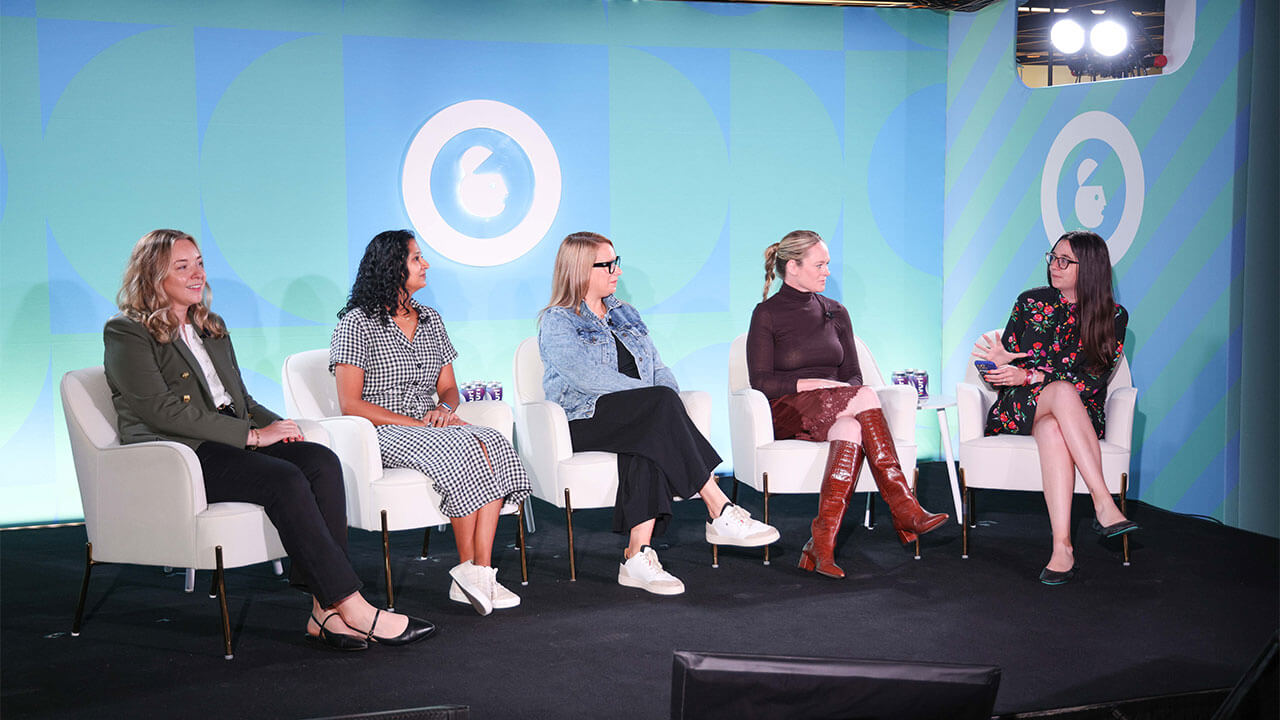
Moderated by our very own Ariel Madway, the event saw Cint’s Michelle Darcy Clarke (Chief Experience Officer) and Bee Meuwissen (Group Chief Human Resources Officer) pair up to discuss the impact of AI on market research roles, and why it shouldn’t be seen as a fear factor for those in the industry.
The conversation specifically addressed a critical industry challenge. While data shows women research professionals face a three-times higher risk of role replacement due to automation, they are currently adopting AI tools at a slower rate.
Instead of treating this shift as an obstacle, the panel explored how to turn this adoption gap into a career advantage. They covered the practical barriers holding professionals back, everyday ethical dilemmas, and strategies for moving from task execution to proactive AI leadership.
Read on to get some vital insights from an illuminating and enlightening session on the topic that everyone in research is talking about.
Attendees were asked how regularly they make use of AI tools in their working lives. For this cohort, 75% use it daily, 23% occasionally seek assistance in the form of an AI product, and a tiny but determined 2% never interact with AI.
Reflecting on the live data, Darcy Clarke commented that when it comes to AI, “Frequency matters. More frequent users are all in, less frequent users are hesitant.”
The figures in the webinar differed slightly from what we saw in our report from earlier in 2026, where 58% of respondents in the research sector occasionally use AI in professional lives, with a further 24% using it daily.
That report also turned in a fascinating insight: management staff are far more likely to at least occasionally make use of AI products than their non-management counterparts, and we saw similar results when it came to daily use, too.
We also saw in our webinar the trickle down effect of this when it comes to the encouragement of slotting AI into existing workflows. 57% of those who took part in the live poll consider themselves to be very encouraged to use AI, 28% are moderately encouraged to do so, and the remaining 14% are only slightly encouraged on this front.
Can entry level roles thrive alongside AI?
Much of the wider conversation around the long-term implications of AI adoption in the workplace centers around the impact it may have — and is arguably already having — on entry level roles across different industries and sectors.
“There’s a lot of commentary suggesting entry-level roles could become extinct, but these jobs aren’t a 1:1 replacement with AI,” said Darcy Clarke. “If you start as a data processor or an account manager in market research, you will simply learn how to do the job using the tools available in front of you. Entry-level roles evolve. We still need people to teach, hone, and mentor; they just step in at a different time, utilizing different tools.”
The crucial shift, then, is to make AI adoption a standard part of career development, rather than an additional set of responsibilities.
“Generally speaking, AI is speeding things up even further, creating a certain intensity as we try to keep up with the machines. But we’ve done this before. When PCs were introduced, the world changed; the internet changed the world again. New technology can always feel overwhelming,” said Meuwissen.
She continued, “What you read in the press can be terrifying, especially the statistics around AI-related job losses. We need to take the hype out of the equation and focus on our own agency.”
“What you read in the press can be terrifying, especially the statistics around AI-related job losses. We need to take the hype out of the equation and focus on our own agency.”
Bee Meuwissen Group Chief Human Resources Officer, Cint
In practice, this means working out exactly what you want to get better at using AI, and, in Meuwissen’s words, “Just playing around with it, getting a feel for it, and don’t be afraid of the technology behind it. Don’t be too concerned about the noise. Get on calls with your teams, share your use cases, and tell them what helped you.”
Making AI work for your organization
The speakers were asked to provide advice for companies about to embark on their AI journeys, and also took a question from the audience about the skills that won’t be lost in an age of increased automation and reliance on AI solutions.
“Embrace AI and make it work for you,” said Darcy Clarke. “You need to own the narrative around how it is implemented in your organization, and drive adoption from the top down.”
“Embrace AI and make it work for you, You need to own the narrative around how it is implemented in your organization, and drive adoption from the top down.”
Meuwissen’s advice was similarly to-the-point. “Don’t start with the tool itself. Start by thinking through how you want to work, and what’s important to you and your business.”
For Meuwissen this means really honing in on what’s human and unique to your company.
Ultimately, Darcy Clarke stated, the goal is to find use cases for AI that “Make our customers’ lives easier and our research better. Start small and go from there.”
When it comes to considering skillsets, Meuwissen admitted that, “Skills might go out of data faster in the future than they do today,” but framed this as a chance for the human factor to take centre stage.
“Personality traits are becoming more important. Curiosity is very important, as is leaning into the new, working through the ambiguities it brings,” she said. “Those traits are important to foster for yourself and to look for in your manager and your teams. Fundamentally, human skills and abilities, and the need to connect with others will continue.”
Darcy Clarke also took a human-centred approach to the question. “AI can help and support our work in market research but we need humans. Research is built on humans; even synthetic data is built on human data. That human need isn’t going away.”
Read more about our AI report
Want to know more about our 2026 report into AI? Head here to download Friend or foe? The human-AI relationship from Slack to the sofa in full now.
As AI fraud rings threaten market research, validated synthetic data offers a defense. Discover how to protect data integrity from automated deception and preserve trust.
Understand what first-party data is, why it’s crucial for a modern data strategy, and how you can effectively collect, manage, and enrich it for insights.
Get the low down on what Cint CEO Patrick Comer and VP of Trust and Safety Jimmy Snyder had to say about combating fraud while protecting the respondent experience.
Learn how to calculate and measure ad recall, brand awareness, consideration, message association, and brand attribute lift to optimize your ad campaigns.
Learn how reliable, accurate survey data leads to stronger decision-making, better targeting, and optimized resource allocation for effective insights.
Cint’s Wilson Peters (VP, Global Customer Success) and Delineate’s James ‘JT’ Turner (Founder and CEO) discuss the importance of research when it comes to connecting with consumers.
Explore how survey design, inclusive language, and community engagement can help us create research that reflects the full diversity of human experience.
Director of Product Management at Cint, Stephanie Gall, joined the EMARKETER podcast to discuss how to make better campaign decisions in periods of flux.
Feeling the pinch but still need to deliver? A panel of experts headed by Cint’s Laura Manning discuss strategic approaches to media measurement during a period of flux.
Live at the Advertising Week Europe event in London, April 2025, Advertising Week’s Katie Ingram and Cint’s Ariel Madway took the stage to unpack generational divides.
Survey design can have a dramatic impact on the quality of your research. Download our guide to find out how to improve survey experience for respondents and reduce drop-off rates.