
Contents
- The real cost of fragmented supply
- Ditching sample bias by design
- Reaching every market from one source
- Solving respondent identity once
- One profiling standard for every supplier
- A marketplace built for quotas that go beyond single-panel reach
- One source. Not more sources to manage
- What changes when fragmentation ends?
- Frequently asked questions about sample marketplaces
Categories
The real cost of fragmented supply
Research buyers have long faced an unnecessary trade-off: lock into a single panel provider and live with its geographic and demographic limits, or patch together a time-consuming mix of suppliers yourself.
Fragmented supply doesn’t just cost time on manual vendor management and billing – it introduces sampling bias, duplicate respondents, and inconsistent quality checks. The fix isn’t another supplier. It’s moving to a unified sample marketplace, like Cint Exchange.
Ditching sample bias by design
Any single recruitment channel carries inherent sample bias – data skewed toward specific traits or groups rather than the wider population.
The Cint Exchange makes your sample bias-resistant by design: instant access to 800+ integrated suppliers, selectable and blendable in a few clicks, eliminating that risk at the root rather than patching it after the fact.
Reaching every market from one source
Expanding research on a global scale usually involves onboarding regional vendors, navigating separate contracts, and having to manage inconsistent quality standards. A single panel provider’s geographic footprint inherently limits the reach of your research.
Sample from over 130 countries sits behind one connection on the Cint Exchange. Whether your study needs a hyper-specific cohort across five international markets or a broad, national-level sample, supply is available immediately without adding operational overhead.
Solving respondent identity once
Cross-network duplication is a persistent risk in managing independent supply partners – panels can’t see each other’s respondent databases, so the same person can complete your survey twice through different channels.
A unified global ID system tracks, verifies, and deduplicates respondents across the entire Cint Exchange before they ever reach a survey, cutting duplicate entries at the source instead of hours of manual cleanup after the fact.
One profiling standard for every supplier
In a fragmented supply landscape, where you’re jumping from vendor to vendor, the definitions of audience segments may differ across providers. Fraud controls can differ between vendors, too, and that inconsistency can lead to costly issues regarding data quality.
A single global profiling standard applies across all 800+ suppliers on the Cint Exchange. Every partner undergoes strict pre-onboarding vetting, and our dedicated Trust & Safety operations team runs multiple automated fraud and attention checks throughout the survey workflow – a standardised quality bar across every respondent journey.
A marketplace built for quotas that go beyond single-panel reach
The need to target niche audiences, low-incidence consumer segments, and complex quota grids often stall when you’re relying on single panels for your research needs. Sourcing additional sample manually takes days and risks delaying time-to-insights.
By combining the breadth of 800+ suppliers on a single engine, the Cint Exchange fills challenging quotas faster. Initial survey responses typically arrive within hours (or under 60 minutes for broader targets) with live reporting updating in near-real time.
One source. Not more sources to manage
Managing multiple suppliers wastes valuable time on negotiations, setup, and billing, which is time that should be spent on analysis and coming to confident data-backed decisions.
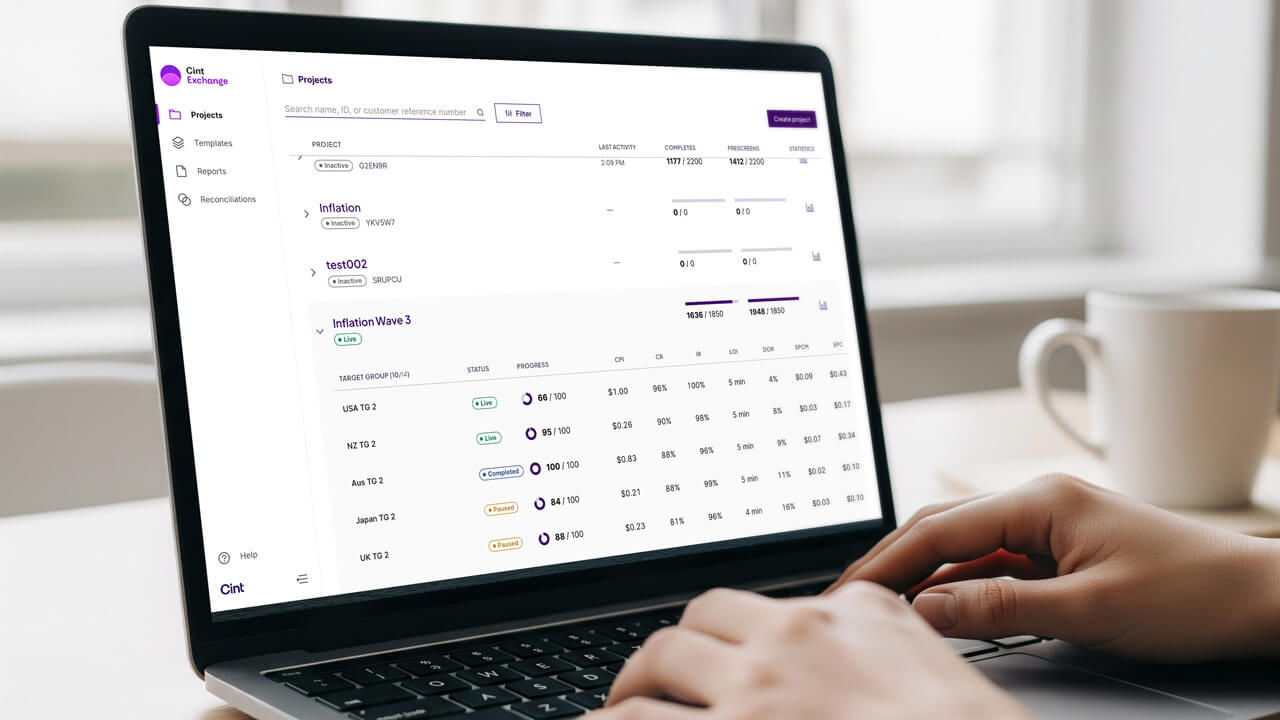
Bringing everything under one platform – reusable allocation templates, automated fielding, and automated reconciliation – cuts the administrative friction of managing multiple vendors. Projects launch in as little as two minutes, reconciliation drops from days to hours, and pricing stays predictable throughout.
What changes when fragmentation ends?
Fragmented supply doesn’t just waste your team’s time or budget – it undermines trust in the data itself.
A unified marketplace like the Cint Exchange fixes that at the root: one platform, one profiling standard, one quality bar – so you’re working with complete confidence in your insights, not managing risk after the fact.
| What you need | What you’d typically get elsewhere | What you get with the Cint Exchange | Why it matters |
|---|---|---|---|
| Supply without bias | Recruitment tied to one channel, or a handful of vendors stitched together by hand | 800+ integrated suppliers, selectable in a few clicks – full control over the mix behind every project, trusted by 4,000+ insights-driven companies. | Sample that’s bias-resistant by design, not corrected after the fact. |
| Geographic reach | Coverage limited to wherever that one source already has a footprint. | 130+ countries on one platform, targetable hyper-locally or globally at once. | One unified platform for everything from a national study to a multi-country niche quota. |
| Respondent identity | Each vendor dedupes within its own network at best – cross-network duplicates are hard to catch without a shared ID. | A unified global ID tracks and verifies respondents across the whole Cint Exchange, making recontact or exclusion straightforward. | No duplicate entries distorting your response count or slowing you down – just clean data, ready for analysis. |
| Profiling standard | Workable standards, but definitions can vary from vendor to vendor. | One standardised, global profiling system – all 800+ suppliers required to qualify respondents the same way. | Consistency you can rely on – every response comes from an audience assessed against the same criteria. |
| Niche and hard-to-reach quotas | Niche quotas can be fillable, but fielding often stalls or the study risks under-filling. | 800+ suppliers across 130+ countries, with first responses typically arriving within hours and results visible in near-real time. Automated settings keep cost per interview at a market clearing price, or let you raise incentive on the toughest quotas to reach restrictive demographics and prioritize urgent work. | Quotas that would’ve stalled elsewhere get filled – with room to flex incentive or timeline if the audience calls for it, not endless manual sourcing, saving you time and money. |
| Quality and fraud prevention | Fraud tooling is common industry-wide; consistency is what varies most when supply is pieced together from multiple vendors. While real safeguards exist, standards vary vendor to vendor and inconsistency is where fraud gets through. | Every supplier is vetted before joining; a dedicated 20-person Trust & Safety team runs 10+ fraud and attention checks through the workflow, removing fraudulent activity before it ever enters a survey. Quality runs through multiple independent layers – filtering, fraud protection, and respondent experience checks – each catching what the last missed, backed by the Cint Trust Score, a proprietary AI-powered scoring model that grades every respondent on entry and predicts problem sessions before they happen. | Confidence in real, engaged people – every time, not just from your preferred vendor. |
| Managing supply | Manageable with one vendor; negotiating and reconciling across several is time consuming. | Reusable allocation templates, automated fielding, and automated reconciliation – all on one platform, with budget set upfront and boost available if you need it. | Projects launch in as little as two minutes; pricing stays predictable throughout and reconciliation drops from days to hours. |
Frequently asked questions about sample marketplaces
A single-source panel relies on one proprietary network of respondents, limiting reach, volume, and recruitment diversity. A sample marketplace aggregates hundreds of independent, vetted supply partners into a single platform governed by unified profiling standards, automated fraud detection, and centralized respondent deduplication.
No. It simplifies operations by unifying procurement into one platform and contract, eliminating the friction, negotiation, and overhead of managing multiple panel vendors. Pricing is also driven by real-time supply and demand, so you’re paying a fair, market rate per respondent type rather than a fixed markup.
No. Instead of building and maintaining custom integrations for every individual supply partner, the Cint Exchange connects directly to your existing infrastructure through a single Demand API. Dedicated integration consultants also help customize your setup at no extra cost.
Every supplier on the Cint Exchange must undergo rigorous vetting and adhere to a global profiling standard. Cint applies a second layer of security using a dedicated Trust & Safety team and automated fraud and attention checks throughout the respondent journey to catch bad actors before data collection finishes.
Read more about the Cint Exchange or connect with our team today to see how a unified marketplace can transform your research workflows.