
Contents
- Scaling market research with AI-Moderated Interviews
- How do respondents feel about AIMIs?
- What opportunities do AIMIs offer that weren’t previously possible?
- What are the current limitations of AIMIs?
- What do AIMIs offer respondents?
- How should the industry approach combatting fraud when it comes to AIMIs?
- Watch the webinar in full
- Learn more about Cint’s approach to AI-moderated interviews
Categories
Scaling market research with AI-Moderated Interviews
Agentic AI is helping to narrow the gap between qualitative depth and quantitative scale. At the heart of this shift in the research landscape are AI-moderated interviews, usually referred to as AIMIs.
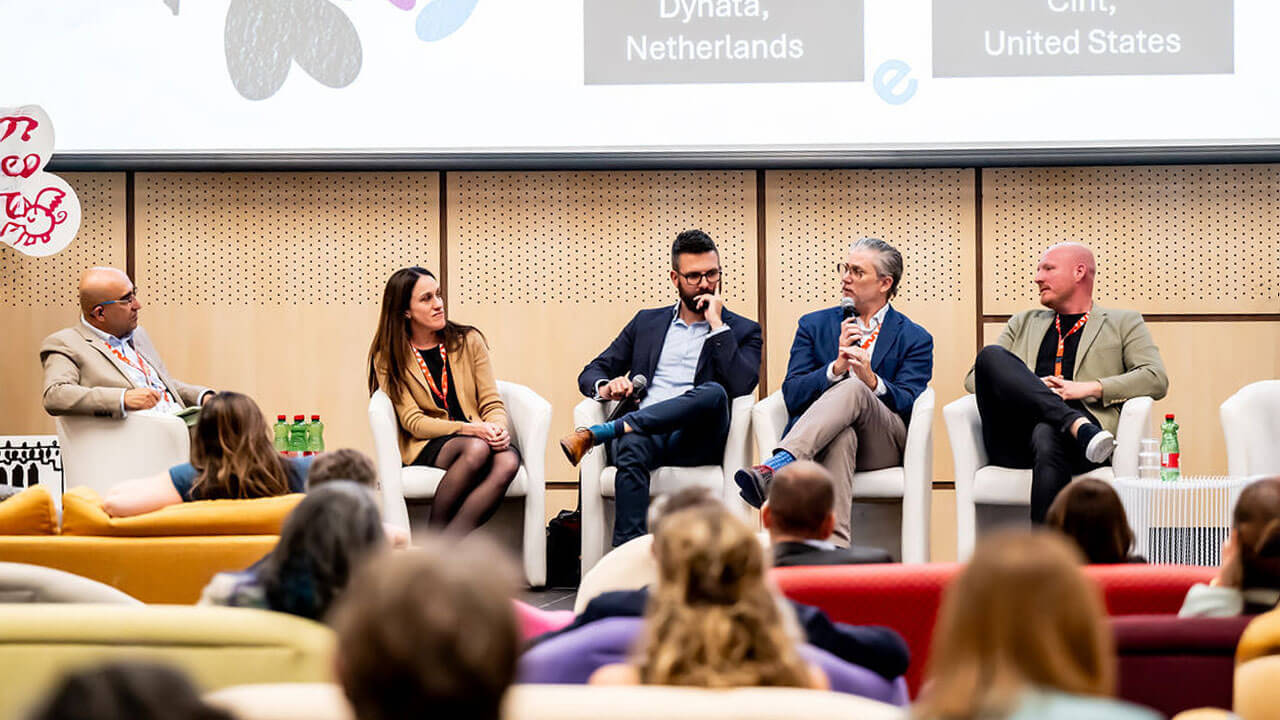
At a recent webinar hosted by Insight Platforms, a panel of experts convened to talk through the means by which AIMIs are helping narrow the gap between qualitative depth and quantitative scale.
Cint’s Bruno Patriota (Senior Product Manager) was joined in conversation by Sergi Perdices, founder of AIMI pioneers, Whyser.
Read on for a recap of an insightful conversation about a technological advance that’s having a massive impact on everyone involved in the market research ecosystem.
How do respondents feel about AIMIs?
A situation where autonomous agents have the ability to deliver the depth of insights achieved from qualitative research at the scale of quantitative research is great for those of us who work in research and measurement, but it is vital to note that it offers benefits to respondents, too.
“AIMIs are an example of where AI tools are being used to both enhance the quality of the answers our respondents are providing, and to probe for deeper, more meaningful insights,” Patriota says.
In the US
76%
are likely to participate in survey sessions that use AI-moderators
In the UK
73%
are likely to participate in survey sessions that use AI-moderators
A recent report conducted and published by Cint demonstrates that respondents resonate with AIMIs: 76% of US respondents and 73% in the UK are likely to participate in survey sessions that use AI-moderators, and around half are in agreement with the notion that AI interviewers feel just as authentic and reliable as their human counterparts.
Head here to read the report in full.
What opportunities do AIMIs offer that weren’t previously possible?
Having established a baseline level of support among respondents for the use of AIMIs, the conversation turned to working through opportunities afforded by AI-interviewers that aren’t possible with traditional surveys or focus groups.
Perdices stated that, “AIMIs allow us to really listen to people, at scale, and in depth. On the quantitative side, we all know that we get a lot of data, at speed, and at scale. However, the insights we get are from answers that we’ve defined in advance. With traditional qualitative research, we have the ability to go deeper with participants but it is with a relatively small number of people. The turnaround is longer and it costs more.”
AI, he posited, allows researchers to bring those two pieces together.
For Patriota, the ability to reach audiences practically anywhere and at any time is a massive boon for researchers and respondents. “Previously, a human researcher had to schedule the sessions, show up on time, and hope that the tech was working. With AIMIs, you can reach people in the comfort of their own homes, where they have the time to offer deep, meaningful insights.”
“Previously, a human researcher had to schedule the sessions, show up on time, and hope that the tech was working. With AIMIs, you can reach people in the comfort of their own homes, where they have the time to offer deep, meaningful insights.”

Bruno Patriota
Senior Product Manager, Cint
What are the current limitations of AIMIs?
In the interest of fairness, the webinar also touched on what might not be working so well. More specifically, both speakers were asked to discuss potential scenarios where an AI interview might fall short.
Patriota stressed that humans still need to set surveys up, think through specific demographic targeting, and the expectations that you establish with respondents. One of those expectations is being up front with participants about the use of AI interviewers — without enough prior warning, some respondents faced with an AI-moderator might drop out of the survey.
Percides was in agreement. “An AI interviewer can be consistent and can follow the rules you’ve set up, but you still have to properly define those. Totally unconstrained probing can lead to inconsistent reactions from respondents.”
The message is simple: While AI can be used incredibly effectively on the execution side, building the strategic thinking behind research studies remains a fundamentally human exercise.
What do AIMIs offer respondents?
We’ve established that a majority of respondents surveyed by Cint are happy to take part in sessions led by AI moderators, but how do they actually work from the perspective of a participant?
A traditional online market research survey might see a participant being asked a question like, “How satisfied were you with your recent banking experience?” before rating it on a scale from 1-10.
An AI-moderated session can probe a little further through clever follow up questions that take some of the onus off the respondent. After all, having to tie a feeling or an experience to a numerical figure isn’t always the easiest of tasks. Rather than attempting to translate an experience into a predefined scale, the respondent can simply explain it to the moderator.
“A respondent’s experience is what drives the difference in the insights you’ll get,” said Percides. “A comfortable participant has a good experience; they’re able to share their thoughts, they won’t click through the survey in a rush.”
“A respondent’s experience is what drives the difference in the insights you’ll get, a comfortable participant has a good experience; they’re able to share their thoughts, they won’t click through the survey in a rush.”
Sergi Perdices
Co-Founder & CEO, Whyser
How should the industry approach combatting fraud when it comes to AIMIs?
Data quality remains one of the hottest topics in market research so it is no surprise that the conversation turned to discussing how the industry can crack down on fraudulent behavior in the AIMI era.
Unlike standard multiple-choice surveys, which are easily exploited by click-bots or superficial text generators, a live, 15-to-20-minute adaptive conversation serves as an intrinsic barrier to fraud.
According to Parcides, combating fraud is a little like a continuous “wall and ladder” race. AI moderation inherently heightens the wall. It is exceptionally difficult for a bot or an open-ended script-filler to successfully fool an AI interviewer that continuously loops back with specific, highly tailored probing questions.
There’s also the fact that a respondent’s experience of a survey is only as good as the work that went into that survey, whether it is delivered by a human or an AI agent.
Despite its promise, AI moderation is not a total replacement for human thought; it has distinct boundaries. For one, an AI interviewer’s output relies entirely on the quality of its structural configuration. As Patriota emphasized, “You will get as good as your input. In other words, it’s how you set this up: if you set up a bad respondent flow, you’re going to get a very bad respondent flow.”
As we’ve explored before, data quality isn’t just a case of pushing back on fraud — it’s about ensuring that everyone who participates in a market research survey of any kind has the best experience possible.
Watch the webinar in full
Beyond these core insights, the webinar panel also explored several additional examples of how AIMI is transforming market research.
Addressing sample size, Patriota and Perdices examined how high-friction audio and video formats impact study feasibility, highlighting the necessity of granular pre-profiling.
They also tackled potential sample bias across different languages, demographics, and cultures, offering guidance on configuring AI moderators to foster participant trust without misleading users.
Looking to the future of the industry, the speakers shared how AI will automate routine execution while shifting human researchers up the stack toward strategy and business impact.
Insight Platforms has made the webinar available to watch in full. Head here for further information.
Learn more about Cint’s approach to AI-moderated interviews
Are you ready to see how AI-Moderated Interviews can help your team scale conversational insights with confidence?
Get in touch with Cint today to discover more.