
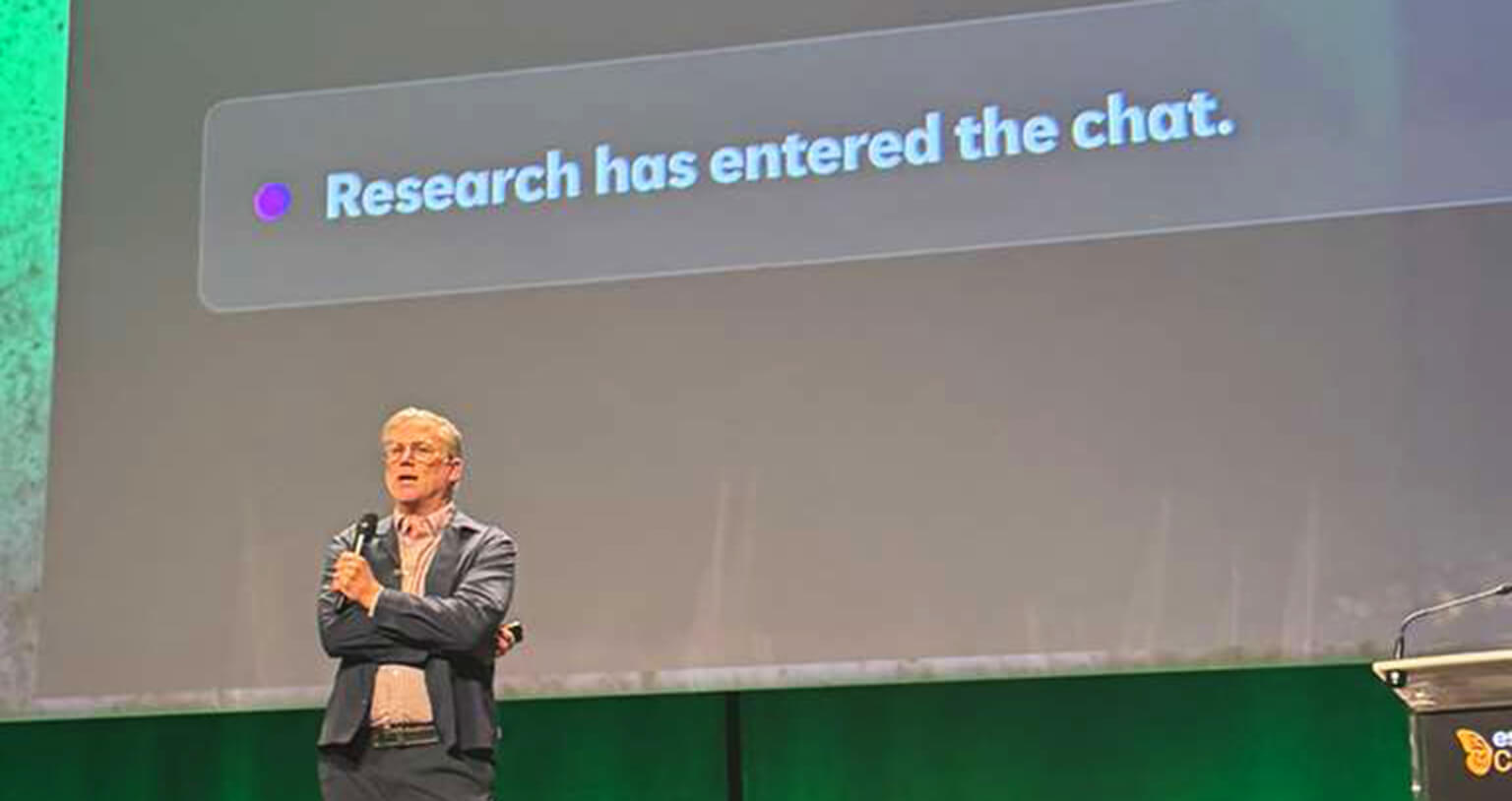
Research has entered the chat
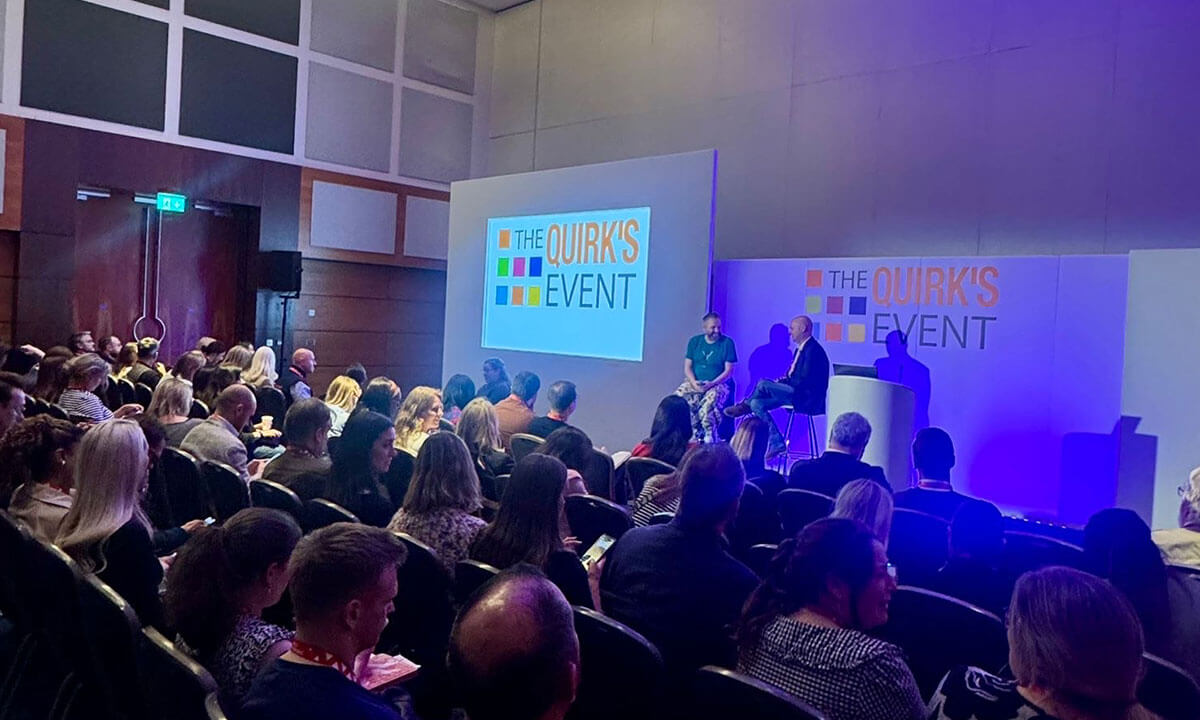
Speaking at the 2026 Esomar Congress, Cint CEO Patrick Comer highlighted a fundamental shift transforming market research: decision-makers across are no longer willing or able to wait for traditional research projects to be ideated, fielded, and completed.
Rather than logging into specialized marketplaces or initiating human-led research workflows, people with questions have begun defaulting to large language models (LLMs) like ChatGPT, Claude, and Gemini, each of which now offer specific research tools as part of their portfolio.
As Comer emphasized to the Esomar audience, this shifts the primary interface for insights to a single chat window: “The majority of business users today start their research question on this pane of glass. Not on mine, not on yours. They’re going to start right here.”
It’s a shift in the research process that, as Comer put it to the audience, “should probably terrify and excite you at the same time.”
Navigating the illusion of accuracy in LLM research outputs
While we all know by now that LLMs can deliver rapid responses on all manner of queries, relying on them for research tasks comes with risks attached.
“If I run a research project on a topic I don’t know much about, an LLM will confidently give me a research report on that entire industry and I won’t be able to tell if it’s good or bad,” said Comer.
When testing specialized industry prompts, Patrick noted that an LLM might “provide about 30% truth and the rest of it’s pretty much nonsense. But how is the normal user supposed to tell the difference? They don’t. They can’t.”
To move from theory into practice, Comer explained how Cint recently conducted a study asking 300 US adults about apparel purchases they’d made in the past 12 months, including brands like Old Navy, Under Armour, and Tommy Hilfiger.
When prompting Gemini, Claude, and ChatGPT with the exact same multi-select question, the LLMs generated outputs that closely tracked real human responses sourced on Cint’s platform. For example, LLMs produced plausible purchase figures for Lands End ranging from 11% to 6%, compared to 5% among real survey respondents.
This theoretically sounds great. But, because the results are just close enough to believe, users might lack the inclination to independently verify whether the data they’ve been presented with is actually grounded in reality.
“If people can get an answer that seems reasonably accurate enough for the problem they’re trying to solve today, are they going to go to their research department and ask the next question? Probably not,” said Comer.
From traditional channels to AI agents
Historically, researchers have conducted their work through three main engagement models: managed services, self-service platforms, and platform-to-platform APIs.
“All of these three assume one simple fact: that there’s humans involved on both sides, and all these humans have time to do all of this work,” Comer said. “The difference is now something else presents into the room. And that is the agent itself.”
The arrival of the aforementioned autonomous AI agents alters the equation. Rather than a human logging into a platform or managing a developer workflow, the agent itself steps directly into the room and can oversee research workflows.
“My prediction, for better or worse, is that the largest buyer of research data long term will be agents, not people,” said Comer. “In fact, agents will be purchasing and requesting research at a higher rate than humans have ever done.”
“My prediction, for better or worse, is that the largest buyer of research data long term will be agents, not people. In fact, agents will be purchasing and requesting research at a higher rate than humans have ever done.”

Patrick Comer
CEO, Cint
Bridging AI agents and research data with MCPs
At the forefront of this shift in how research functions is what is known as the Model Context Protocol, MCP for short. In simple terms, Comer said, “MCP is the language model that LLMs and autonomous agents use to integrate and talk to each other.”
Think of MCPs as a standardized framework that bypasses human-driven interfaces. Accordingly, they allow research teams to execute multi-step research projects directly within their primary AI tools, eliminating custom coding, reducing platform hopping, and keeping data connected.
“MCPs provide the intent, the skill, and how-to-use the processes such that an agent can learn how to order sampling, how to run a project, how to design a survey, how to deliver insights without having to ask,” said Comer.
During the presentation at Esomar, Comer shared details of Cint’s brand new MCP implementation, which operates inside Claude, Anthropic’s pioneering LLM.
Even at this stage, our MCP is demonstrating several clear capabilities that should excite everyone involved in the research and measurement industries:
At the forefront of this shift in how research functions is what is known as the Model Context Protocol, MCP for short. In simple terms, Comer said, “MCP is the language model that LLMs and autonomous agents use to integrate and talk to each other.”
Think of MCPs as a standardized framework that bypasses human-driven interfaces. Accordingly, they allow research teams to execute multi-step operations directly within their primary AI tools, eliminating custom coding, reducing platform hopping, and keeping data connected.
“MCPs provide the intent, the skill, and how-to-use the processes such that an agent can learn how to order sampling, how to run a project, how to design a survey, how to deliver insights without having to ask,” said Comer.
During the presentation at Esomar, Comer shared details of Cint’s brand new MCP implementation, which operates inside Claude, Anthropic’s pioneering LLM.
Even at this stage, our MCP is demonstrating several clear capabilities that should excite everyone involved in the research and measurement industries:
- Zero learning curve: The AI agent interprets natural language commands to configure audience sampling without requiring human training.
- Proactive quality auditing: In early testing, the agent independently audited target profiling questions, identifying translation errors in Italian language parameters without human intervention.
- Streamlined execution: Projects are designed and launched without setup meetings or manual interface navigation.
“We’re still very early on our journey in our work with some of our partners with MCP, there’s still a lot to learn,” admitted Comer. “But what we’ve discovered is that agents will start gobbling up this data ridiculously fast.”
Research has entered the chat. Our question is: how will you?
You can read more about the impact that MCPs are having on market research and media measurement here.